
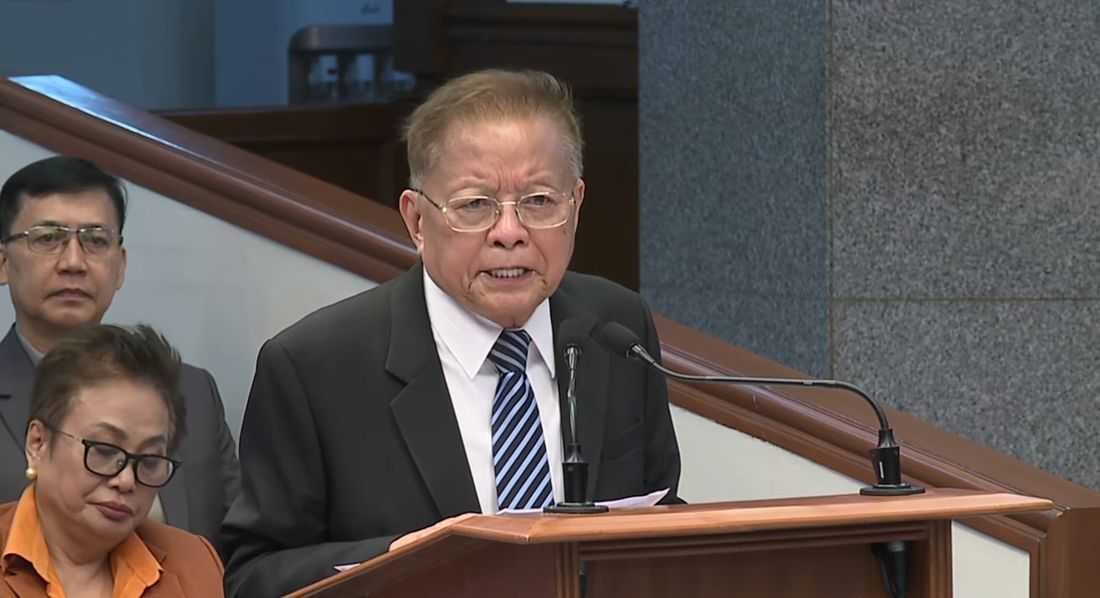
Retired Chief Justice Reynato Puno said Wednesday that the Senate, sitting as an impeachment court, has the constitutional authority to interpret provisions governing impeachment trials and decide cases brought before it.
Speaking as an amicus curiae or “friend of the court,” Puno cited Article 11, Section 3(6) of the 1987 Constitution, which states that the Senate has the “sole power to try and decide all cases of impeachment.”
“My respectful submission, your honors, is that the Senate, as an impeachment court, possesses the power to interpret the meaning and nuances of that sentence,” Puno said
“That power is derived from Article 11, Section 3(6) of the Constitution itself, which expressly provides the Senate shall have the sole power to try and decide all cases involving impeachment,” he added.
Puno said this authority necessarily includes the power to interpret the constitutional provision requiring the concurrence of two-thirds of all Senate members to convict an impeached official.
He argued that a strict, stand-alone reading of the provision is only one approach to constitutional interpretation and that a contextual or holistic approach may also be applied by considering related provisions and the purpose of the Constitution.
According to Puno, treating the two-thirds requirement as a fixed 16-vote threshold could result in “absurdities” or injustices under circumstances where some senators are legally unable to participate in an impeachment trial.
“It says two-thirds of all members of the Senate. By using two-thirds, the number of votes to convict will have to move depending on certain factors. But more than that, a strict, stand-alone literal interpretation of Article 11, Section 3(6) may result in absurdities and may result in injustices, which will defeat the purpose of the Constitution.”
He said the Senate may therefore consider whether senators who are dead, have resigned or been expelled, or are legally incapacitated should be included in determining the number of votes required for conviction.
“This approach will give the Senators the right to consider whether Senators who are already dead, resigned, or expelled should still be counted in determining two-thirds of all the members of the Senate.”
Puno also maintained that the Senate impeachment court is not under the supervision of the Supreme Court in exercising its constitutional power to try and decide impeachment cases.
“In discharging this judicial power, the Senate Impeachment Court is not under the Supreme Court.”
“The senator judges are not like the judges of the regular courts of law who are all under the supervision of the Supreme Court.”
However, he said the Supreme Court may review certain actions of the impeachment court when constitutional rights are violated, including the unjustified exclusion of a senator-judge or the denial of a respondent’s right to fair and impartial judges.
Puno further noted the constitutional provision should not be treated as a rigid mathematical formula, emphasizing that the use of a fraction rather than a fixed number allows consideration of circumstances affecting senators’ ability to participate.
The remarks came as the Senate impeachment court considers the disputed voting threshold in the impeachment trial of Vice President Sara Duterte.
Four retired Supreme Court justices, including Hilario Davide Jr., Artemio Panganiban, and Adolfo Azcuna, were invited to provide legal guidance on how the constitutional two-thirds requirement should apply when some senators cannot participate.
Watch the full video statement below:
