
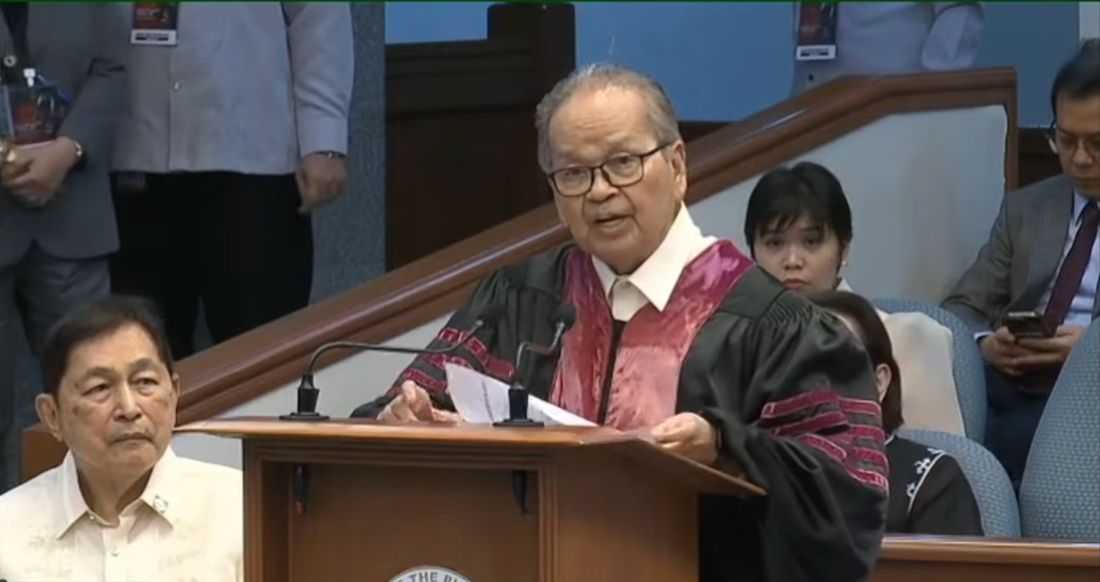
Retired Supreme Court Chief Justice Artemio Panganiban on Wednesday stressed the importance of active participation by senator-judges in the search for truth and fairness as they deliberate on the voting threshold and impeachment case against Vice President Sara Duterte.
Speaking as an amicus curiae during Day 26 of Duterte’s impeachment trial, Panganiban said the Senate’s constitutional duty to try and decide impeachment cases should not be reduced to “abstract mathematics,” particularly in determining the number of votes needed for conviction.
The Senate impeachment court is holding the hearing to seek legal guidance on whether the constitutional requirement of a two-thirds vote should continue to mean 16 votes out of the Senate’s 24 members, even when some senators are unable to participate in the proceedings.
Panganiban said senator-judges should interpret their constitutional mandate based on two fundamental standards: truth and fairness.
He said truth should be established through the examination and verification of documents submitted by the parties, as well as through hearing witnesses and observing their demeanor while testifying.
“Fairness, on the other hand, demands that we hear before we condemn, and that all sides are given the opportunity to explain their language and actions,” Panganiban said.
He emphasized that active participation and independent evaluation of evidence are essential for senators to fulfill their constitutional responsibilities in an impeachment trial.
Panganiban questioned whether it would be truthful and fair for senators to vote on the case despite being absent from the proceedings and unable to review evidence, hear testimonies or observe witnesses.
He specifically raised the issue of senators who may be abroad, detained, hiding from authorities, hospitalized or otherwise unable to attend the proceedings.
“Is it truthful and fair to allow senators to cast their votes despite being absent from the proceedings?” Panganiban asked.
He also questioned whether it would be fair to the parties, the country and the public for senators who had not participated in the hearings to cast votes alongside those who had attended the proceedings.
Panganiban said the Senate must hear both prosecution and defense witnesses, allow their lawyers to present arguments and study the evidence before issuing its orders and decisions.
He acknowledged that the Constitution provides that no person may be convicted in an impeachment case without the concurrence of two-thirds of all members of the Senate. With 24 senators, that translates mathematically to 16 votes.
But Panganiban said constitutional interpretation cannot always stop at mathematical computation, arguing that the provision must also be considered in light of its purpose and the circumstances under which it operates.
He said the Senate, unlike a regular court, is composed of elected political leaders who are not required to be lawyers or jurists. Senators therefore should decide impeachment cases according to their mandate as representatives of the people, guided by truth and fairness.
Panganiban further said a Senate impeachment decision is generally final and cannot be appealed to the Supreme Court. Judicial review, he said, may arise only when the Senate commits grave abuse of discretion, or acts in a capricious, whimsical or arbitrary manner amounting to a lack or excess of jurisdiction.
The Senate impeachment court invited Panganiban and other retired Supreme Court justices to provide guidance on the disputed voting threshold. Retired Chief Justices Reynato Puno and Hilario Davide Jr., and retired Associate Justice Adolf Azcuna are also participating, with Davide submitting a legal memorandum instead of appearing in person.
The issue stems from questions raised by senator-judges on whether the phrase “all the Members of the Senate” under Article XI of the Constitution should automatically refer to all 24 senators, despite the absence of some members from the impeachment proceedings.
Panganiban concluded that meaningful adjudication of the impeachment case requires senator-judges to actively participate in the search for truth and fairness.
“Meaningful adjudication requires active participation in the search for truth and fairness,” he said.
Watch the full video statement below:
