
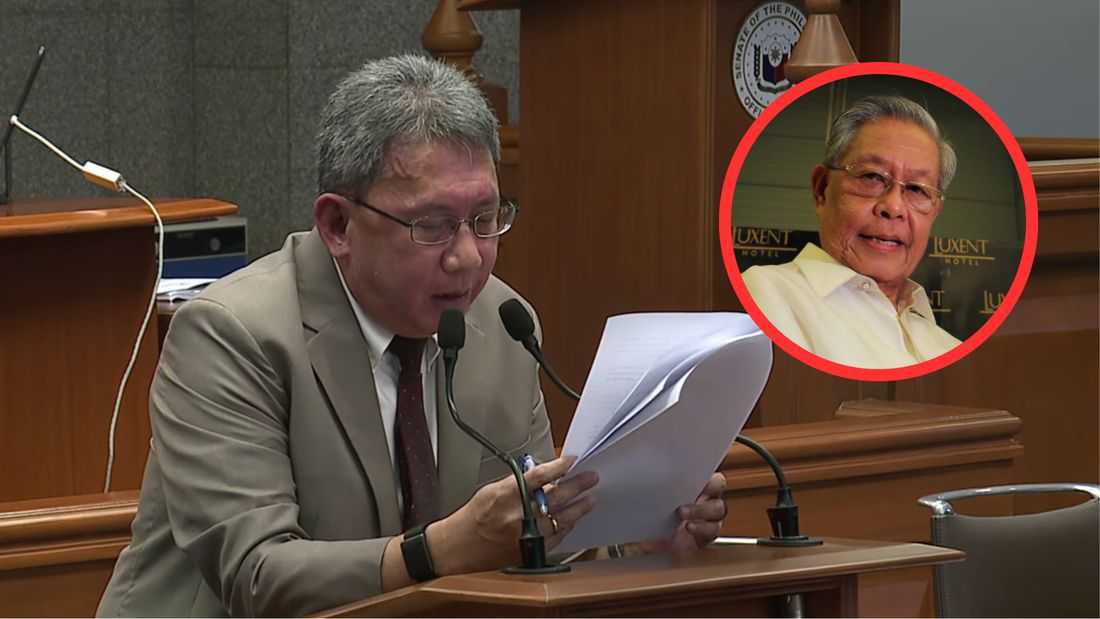
Retired Supreme Court Chief Justice Hilario Davide Jr. maintained that a two-thirds vote, or 16 senators, is required to convict Vice President Sara Duterte in her impeachment trial.
Davide’s position was read by Impeachment Clerk of Court Atty. Renato Bantug Jr. during the Senate impeachment court’s amicus curiae hearing Wednesday, Sept. 16 during the 26th day of Duterte’s impeachment trial.
Davide was unable to physically attend the hearing because of a medical procedure.
In his legal memorandum, Davide said there was no debate on the phrase “all members of the Senate” during the deliberations of the 1971 Constitutional Convention and the 1986 Constitutional Commission.
He said it was presumed that when the Constitution referred to two-thirds of all members of the Senate, the term “members” referred to living senators who were capable of exercising their powers and performing their duties, and who were not prevented from doing so by legal restraints or impediments.
Davide said the framers of the 1935, 1973 and 1987 Constitutions could not have intended to include in the phrase “all members” senators who had resigned or been expelled, or those suffering from mental or physical conditions that rendered them incapable of performing their duties.
He also cited senators who were outside the jurisdiction of the Philippines, whose whereabouts were unknown or who could not participate in the impeachment proceedings.
Davide said senators who are detained, abroad, suspended or whose whereabouts are unknown should be excluded from the phrase “all the Members of the Senate.”
“Those who are detained, abroad, suspended or whose whereabouts are unknown cannot be included, or must be excluded, from the phrase 'all the Members of the Senate,” said Davide in his legal memorandum.
On Avelino vs. Cuenco, Davide said the Supreme Court ruling was not directly applicable to impeachment cases because the case involved the Senate acting exclusively as a legislative body.
He said the ruling could nevertheless provide guidance by analogy.
“The matter in issue in this Avelino vs. Cuenco case was purely relative to the determination of quorum in a Senate exclusively acting as a legislative body, and performing exclusively legislative functions, and not as an Impeachment Court.”
Davide also addressed whether a senator-judge who did not attend or substantially participate in the impeachment proceedings could vote on the final question.
He said a senator-judge who did not attend any session of the impeachment court or never performed the duties of a senator-judge should be deemed to have never participated in the performance of those duties.
For senators who did not substantially participate in the impeachment proceedings, Davide left the matter to their “conscience and sense of duty.”
"A Senator-Judge who did not attend any session of the Court for any reason whatsoever or who never acted or performed the duties as a Senator-Judge must be deemed to have never participated in the performance of the duties as such,” the retired justice said in his letter.
“He should belong to the category of those who are outside the jurisdiction of the Philippines or in a foreign country or one whose whereabouts are unknown,” his letter further noted.
Davide was among the delegates to the 1971 Constitutional Convention that drafted the 1973 Constitution and was one of the commissioners of the 1986 Constitutional Commission that drafted the 1987 Constitution.
