
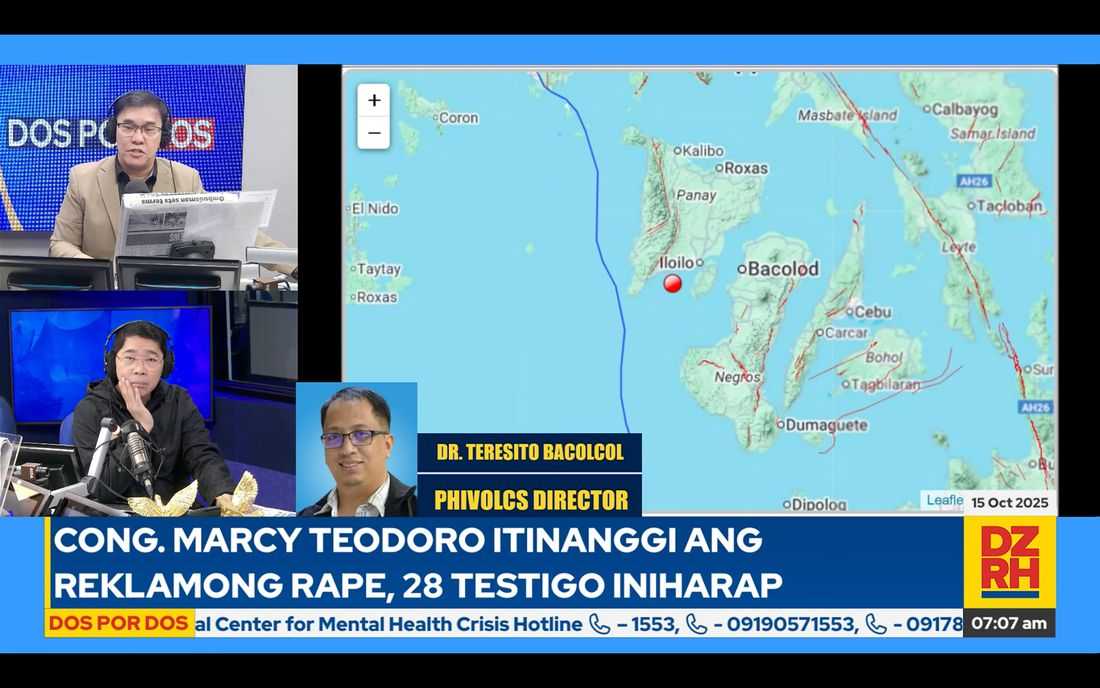
PHIVOLCS Director Dr. Teresito Bacolcol said the West Valley Fault — which runs through parts of Metro Manila and nearby provinces — is now approaching what scientists describe as the “lower boundary” of its recurrence interval, meaning it is entering the period when movement along the fault becomes statistically possible.
In an interview on DZRH’s Dos Por Dos program, Bacolcol explained that the fault’s recurrence cycle — or the estimated time between major movements — spans 400 to 600 years, based on historical and geological data.
“When we say ‘hinog na,’ kasi papalapit nang papalapit na tayo doon sa lower boundary ng recurrence ng West Valley Fault kasi ang sinasabi natin ang West Valley Fault would move every 400 to 600 years. Last time it moved was in 1658, so ang lower boundary niya 400 years, that would be around 2058,” Bacolcol said.
While nearing the 400-year mark has raised public concern about the so-called “Big One,” Bacolcol emphasized that this does not mean a major earthquake will automatically occur within that period.
“Hindi naman ibig sabihin ay mangyari ‘yan by 2058. It could be earlier, it could be later, or pwede ring mangyari ‘yan in between. Ang sinasabi lang natin ay papalit nang papalapit tayo doon sa lower boundary,” he clarified.
The PHIVOLCS chief reminded the public that the term “hinog na” only refers to the fault’s readiness based on its geological timeline, not a guarantee of imminent movement. He reiterated that no existing technology anywhere in the world can predict exactly when, where, or how strong an earthquake will be.
“In other words, walang technology that can tell us exactly when an earthquake will happen,” Bacolcol said.
Unrelated Quakes Nationwide
Addressing public fears of a possible “chain reaction” of tremors, Bacolcol also clarified that the recent earthquakes in Cebu, Davao, Baguio, and Zambales were not interconnected, as they were generated by different fault systems and trench structures.
“Wala pong koneksyon ‘yong nangyari [na lindol] sa Cebu, Bogo Bay Fault ‘yong nag-produce niyan. Itong sa Davao is the Philippine Trench, sa Baguio ay Philippine Fault, at sa Zambales naman ay Manila Trench. Hindi magkakaugnay ‘yan,” he explained.
PHIVOLCS continues to monitor seismic activity across the country through its nationwide network of observation stations, reminding the public that the Philippines’ location along the Pacific Ring of Fire naturally exposes it to frequent earthquakes and volcanic activity.
