
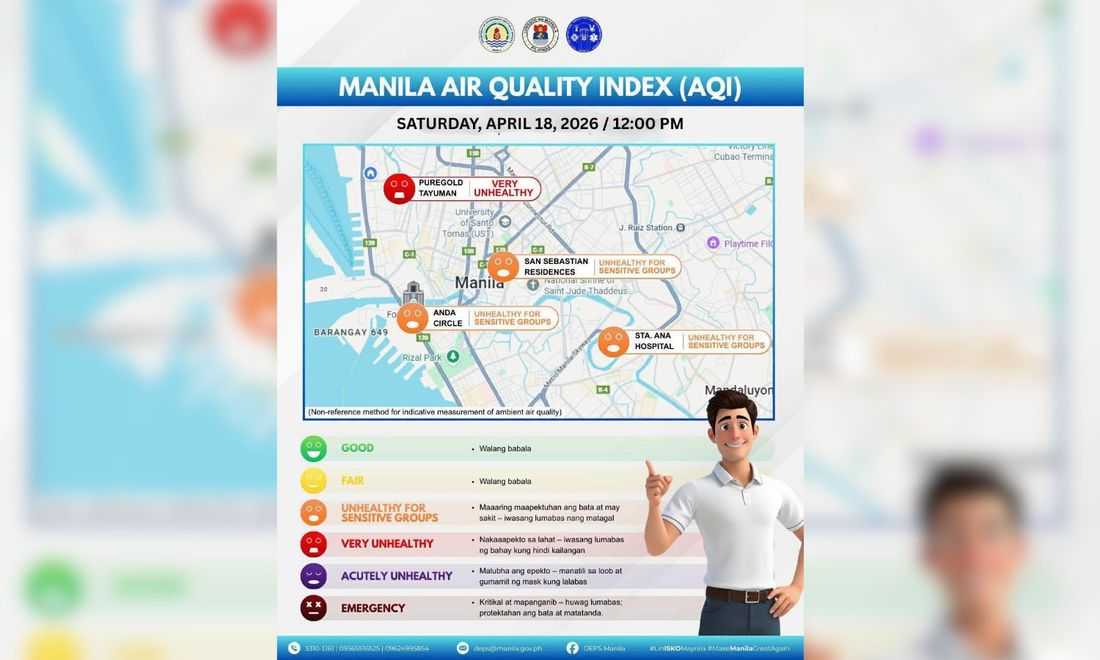
The local government of Manila issued a warning on Saturday, April 18, after air quality in several parts of the city reached “unhealthy for sensitive groups” to “very unhealthy,” raising health concerns among residents.
Based on 12:00 noon monitoring from four air quality stations under the Asia Blue Skies Project, “unhealthy for sensitive groups” levels were recorded in Anda Circle, San Sebastian Residences, and Sta. Ana Hospital. Meanwhile, air quality in the Puregold Tayuman area was classified as “very unhealthy.” In response, city authorities advised the public—particularly those in affected areas—to limit outdoor activities and wear face masks to reduce exposure to polluted air. The advisory was more strongly emphasized for vulnerable groups, including children, senior citizens, pregnant women, and individuals with respiratory conditions such as asthma, urging them to remain indoors and avoid prolonged outdoor exposure. The Manila Public Information Office (PIO) reiterated these precautions, stressing the potential health risks associated with deteriorating air quality. Meanwhile, data from the Environmental Management Bureau of the Department of Environment and Natural Resources (DENR) showed that acutely unhealthy PM2.5 levels were detected as early as 9:00 a.m. in Malabon, Marikina, and Valenzuela. PM2.5 concentrations were also deemed “very unhealthy” in Caloocan, Navotas, and Quezon City, while “unhealthy” levels were observed in San Juan. PM2.5 refers to fine particulate matter, including smoke and combustion byproducts, that can penetrate deep into the lungs and even enter the bloodstream, potentially leading to chronic health conditions. Authorities attribute the poor air quality across Metro Manila and nearby areas to the ongoing landfill fire in Navotas, which began on April 10 and has been burning for nearly two weeks.
