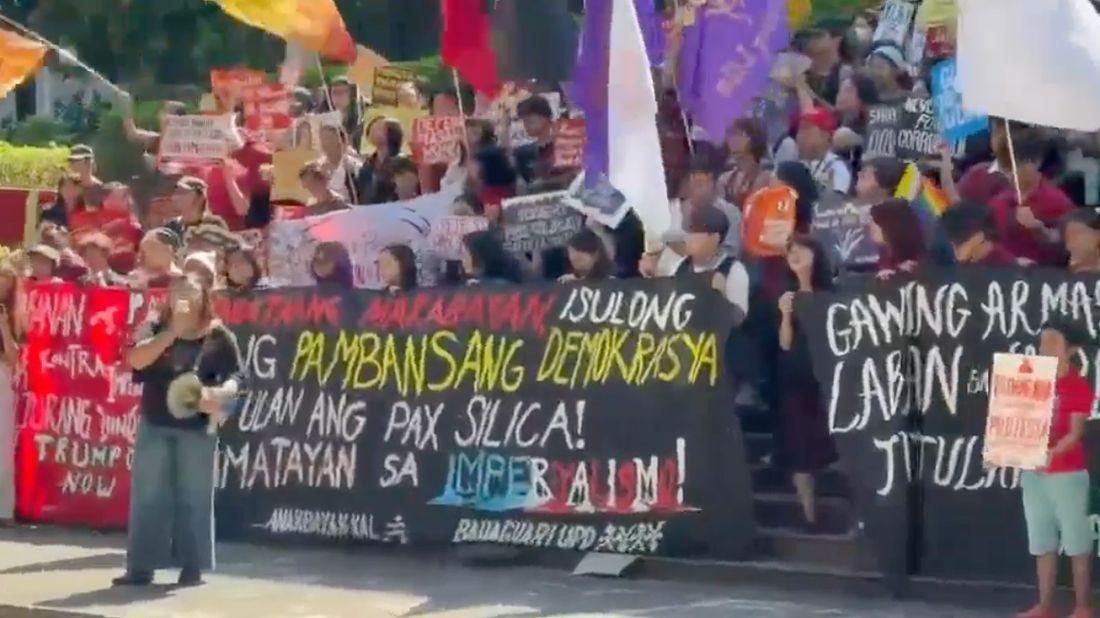
The University of the Philippines Diliman (UPD) University Council Committee on National Programs and Policies (CNPP) called on the Philippine National Police (PNP) to release more than 300 protesters arrested in Metro Manila and nearby areas on Sunday during demonstrations opposing the arrival of United States President Donald Trump and the US-led Pax Silica initiative.
In a statement posted Tuesday, the committee condemned what it described as police “brutality“ and the repression of demonstrators during the country's hosting of the ASEAN Summit.
“We call on the PNP to remove all of its personnel who block the university's entrances and adjacent communities,“ the committee said.
The protesters had opposed Trump's arrival in the Philippines and the US-led Pax Silica, which the committee said threatens ancestral lands.
The CNPP said police blocked a march from Liwasang Bonifacio to the Philippine International Convention Center (PICC), where ASEAN Summit activities were being held. Several protesters were also arrested at a designated freedom park, with one reportedly beaten unconscious.
In a separate incident in Sucat, Muntinlupa City, police violently dispersed the Lakbayan ng Timog Katagalugan and arrested around 300 participants, including 22 media workers and campus journalists from UP Diliman, UP Los Baños, and other schools.
Police reportedly justified the arrests by citing the protesters' lack of permits, their presence outside designated freedom parks, and alleged “obstruction and disruption.“
However, the committee questioned the police's justification, saying the arrests and heavy police presence restricted the public's right to freedom of assembly.
“Yet these arrests, the intimidation, and the heavy police presence show that the government is actively preventing people from exercising their right to freedom of assembly,” the CNPP said.
The committee also raised concerns over the presence of police personnel blocking UP Diliman's entrances and nearby communities, preventing protesters gathered on campus from joining demonstrations in Manila.
The CNPP stressed that Aeta community members staying on campus were not security threats, saying they were in Metro Manila to oppose the US-led Pax Silica initiative, which they believe threatens their ancestral lands.
“The police have no right to suppress them, as well as engage in various forms of harassment and intimidation,” the committee said.
The CNPP also urged the government to allow protests to continue during the ASEAN Summit, despite its earlier recommendation that mass actions be held only after the 49th ASEAN Summit and related meetings.
“These are not sources of embarrassment as these show openness to opposing views and the tolerance of critical reportage,” it said.
“Visiting official delegates have been exposed to such phenomena, fully aware that democratic societies allow freedom of expression, among other basic freedoms. What they rarely witness in their official visits are scenes of police brutality euphemistically called maximum tolerance,“ the group added.
It also said the repression of protests had drawn condemnation from regional and international human rights groups.
The CNPP described the arrests as part of what it called the administration of President Ferdinand Marcos Jr.'s pattern of suppressing dissent, particularly since the anti-corruption demonstrations on Sept. 21, 2025.
The statement also expressed support for previous statements by the UPD Committee on the Protection of Academic Freedom and Human Rights and the vice chancellor for student affairs, which condemned the repression of demonstrators and the arrest of a UPD student.
The committee said UP Diliman faculty members, students, staff, residents, alumni, and other constituents remained committed to defending fundamental rights, including freedom of assembly and freedom of the press.
“We call on the public to stand for the people's right to protest,” it concluded.