
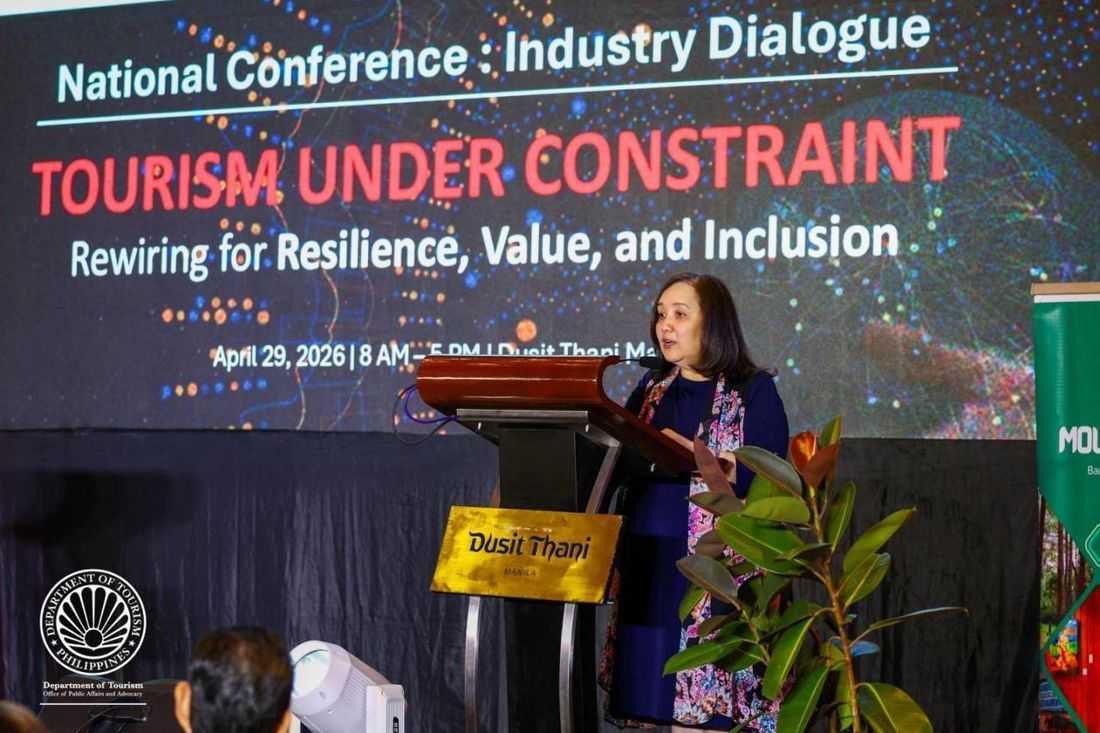
MANILA, Philippines – The Department of Tourism (DOT) will pursue more tourism investments amid the global energy crisis brought about by the situation in the Middle East, while repositioning the Philippine tourism industry for “sustained growth, resilience, and global competitiveness.”
Speaking during a national conference organized by the Tourism Congress of the Philippines (TCP) on Wednesday in Makati City, and attended by more than 300 participants representing all sectors of the tourism industry, Secretary Dita Angara-Mathay underscored that tourism must be treated as an “ecosystem” driven by capital, infrastructure, and coordinated execution.
“I see tourism not just as a sector, but as an ecosystem—one that depends on investment flows, supply chains, enterprise development, infrastructure, and market access,” Secretary Angara-Mathay said.
Structured as a working dialogue, the conference gathered close to 400 stakeholders from the government and the private sector in a direct, solution-oriented discussion focused on strategies for demand recovery, industry adaptability, empowerment of local communities, and inclusive growth.
“We will work closely with hotels, airlines, LGUs, travel operators, digital platforms, transport providers, and community enterprises,” Angara-Mathay assured participants.
The Secretary added that the DOT will take a more active and deliberate role in coordination, particularly in engaging both government agencies and private sector partners.
Focus on High-Impact Tourism Segments
Addressing a room filled with industry executives and leaders, Secretary Angara-Mathay acknowledged the current energy crisis and reports of slower booking conversions and cautious traveler sentiment in certain tourism segments. However, she emphasized that demand for travel remains strong.
“There are reports of slower booking conversions, more cautious traveler sentiment, and cancellations in certain segments. At the same time, demand is not disappearing—it is shifting and rebalancing. From January to April 27, 2026, we recorded 2.24 million international arrivals, up nearly 9 percent year-on-year. What this tells us is simple: tourism demand is still strong—but more sensitive, more selective, and more dynamic,” she noted.
She stressed that domestic tourism remains the foundation of the industry, serving as both a stabilizer during periods of global uncertainty and a driver of regional development.
She added that planned initiatives include strengthening regional travel circuits, promoting short-break travel, and expanding community-based, cultural, and wellness tourism offerings.
The Secretary also identified sectors that “generate higher economic spillover” and encourage longer visitor stays as key priorities.
These include Meetings, Incentives, Conferences, and Exhibitions (MICE); culture and heritage tourism; gastronomy tourism; wellness tourism; farm and agri-tourism; cruise tourism; and events and entertainment tourism, she mentioned.
Attracting Asian and Long-Haul Markets
Secretary Angara-Mathay said the DOT will focus on key source markets such as China, India, Japan, South Korea, Taiwan, and other member states of the Association of Southeast Asian Nations (ASEAN). The Department will likewise sustain efforts in long-haul markets, including North America, Australia, and Europe, to increase tourist arrivals and attract greater investments.
“These markets will be managed with targeted strategies based on demand patterns, connectivity, and conversion performance,” she said.
The Department will also continue pushing for reforms in e-visa systems, entry facilitation, and travel processing efficiency. Parallel investments in data systems and digital platforms will support real-time decision-making and stronger market responsiveness, the Tourism Chief stated.
Enhancing the Visitor Experience
Acknowledging persistent infrastructure and service gaps, the DOT will prioritize improvements in destination readiness, including visitor flow management and safety; clean, accessible, and well-maintained facilities; and the development of organized pasalubong centers to support local micro, small, and medium enterprises (MSMEs), according to the Secretary.
Long-Term Vision with an Ecosystem Approach
For Secretary Angara-Mathay, her leadership will be anchored on stronger collaboration among all players in both the public and private sectors.
“As the lead agency, the Department of Tourism will take a more active and deliberate role in coordination. We will lead alignment across government and industry,” Angara-Mathay said.
“Tourism intersects transport, trade, infrastructure, culture, and local governance—and must function as one system. Our responsibility is to ensure that this system works cohesively, efficiently, and with accountability,” she added.
