
Philippine Coast Guard (PCG) spokesperson for the West Philippine Sea, Rear Adm. Jay Tarriela, challenged China’s claims over the presence of a Chinese research vessel near Hubo Reef, Escoda Shoal and Katimugan Bank, saying international law supports the Philippines’ position on maritime rights and marine scientific research.
In his latest statement on Sunday night, Oct. 11, Tarriela responded to the Chinese Embassy in Manila’s allegations that the Philippine Coast Guard (PCG) "interfered" with the vessel’s operations and violated "China’s sovereign rights and jurisdiction."
The embassy said China has sovereignty over the Nansha Qundao, or Spratly Islands, including Banlu Jiao, Xianbin Jiao and Nanfang Qiantan, as well as their adjacent waters. It maintained that the research vessel was conducting scheduled scientific activities in waters under China’s jurisdiction, while Chinese navy and coast guard vessels were carrying out routine patrols and law enforcement operations.
Tarriela countered that the Chinese statement acknowledged the presence of a research vessel and Chinese naval and coast guard ships in the area, but disputed Beijing’s assertion of jurisdiction over the waters.
Citing the 2016 arbitral award on the South China Sea dispute, Tarriela said China could not treat the Spratly Islands as a single archipelagic unit to claim surrounding waters.
He noted that the tribunal rejected China’s use of archipelagic or straight baselines around the Spratlys as a whole and ruled that none of the high-tide features in the group could generate an exclusive economic zone (EEZ) or continental shelf of its own.
Tarriela also argued that Hubo Reef, Escoda Shoal and Katimugan Bank could not be used as a basis for territorial or maritime claims that would override the Philippines’ rights under the United Nations Convention on the Law of the Sea (UNCLOS).
"Hubo Reef, Escoda Shoal, and Katimugan Bank are not territory," Tarriela noted.
"China's claimed 'sovereign rights and jurisdiction' rests on the same nine-dash-line claim the Tribunal ruled to be contrary to UNCLOS and without lawful effect to the extent it exceeds China's entitlements under the Convention," he added.
Tarriela further maintained that China’s domestic laws could not override its international obligations, noting that Beijing ratified UNCLOS in 1996.
He also disputed China’s characterization of the presence of its navy and coast guard vessels as "routine patrols."
"Warships positioned around a research vessel are not 'routine patrols.' They are escorts. Lawful research does not need naval protection," he noted.
'The PCG interfered with normal operations'
On the allegation that the PCG interfered with normal scientific research, Tarriela cited UNCLOS provisions requiring coastal state consent for marine scientific research in another state’s EEZ.
Under Article 246 of UNCLOS, marine scientific research in an EEZ generally requires the coastal state’s consent. Article 248 sets out information that must be provided in advance, while Article 253 allows a coastal state to require the suspension or cessation of research activities conducted without the necessary conditions being met.
Tarriela said the Department of Foreign Affairs (DFA) had confirmed that China did not seek Philippine consent for the research activity.
“The Philippine position is not unilateral. It is grounded in UNCLOS and the 2016 arbitral award, which states that the award ‘shall be complied with by the parties to the dispute,’” Tarriela said, citing Article 296 of UNCLOS and Article 11 of its Annex VII.
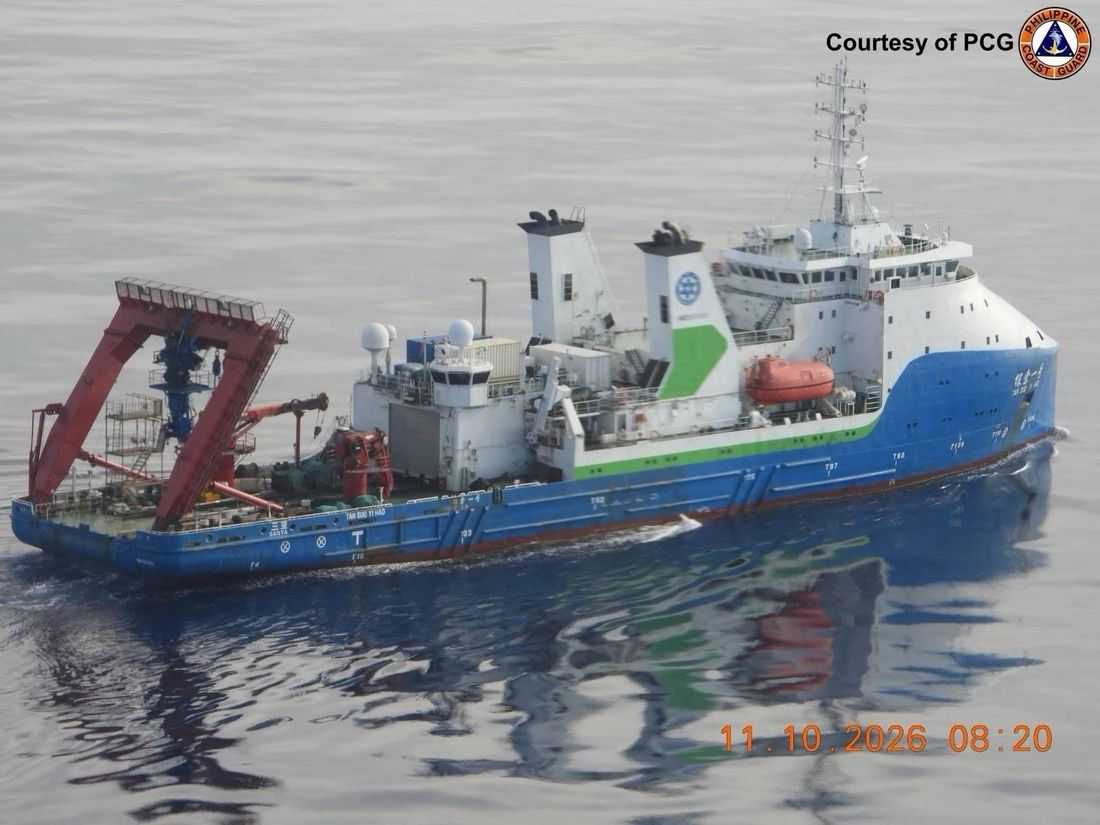
He added that the vessel, identified as Tan Suo Yi Hao, had declared diving operations, gone dark on its automatic identification system (AIS) and ignored repeated radio challenges from the PCG.
"Tan Suo Yi Hao is the mothership for China's deep-sea submersibles. Seabed data has resource and military value, which is why UNCLOS gives the coastal state control over it. Data taken without consent is not a gift to the Philippines," he noted.
He also pointed out that seabed data could have resource and military significance, making compliance with UNCLOS requirements important to the coastal state’s rights.
Earlier, the Chinese Embassy in Manila defended China’s research expeditions in the South China Sea, saying they had been conducted regularly for years and contributed to marine research, ecological conservation, disaster prevention and mitigation, among other purposes, providing what it described as “a wealth of international public goods” from which the Philippines had also benefited.
The embassy accused Tarriela of engaging in what it called “persecution delusion” and attempting to smear China by drawing attention to its scientific research activities.
In response, Tarriela argued that legitimate scientific research should be conducted transparently and in accordance with international law. He said China could seek the Philippines’ consent if its activities were lawful and intended for peaceful purposes.
He also pointed out that seabed data could have resource and military significance, making compliance with UNCLOS requirements important to the coastal state’s rights.
The exchange comes amid continuing tensions between Manila and Beijing over maritime claims and activities in the South China Sea.
The 2016 arbitral award invalidated the legal basis of China’s expansive historic-rights claims to the extent that they exceeded the maritime entitlements permitted under UNCLOS. China has rejected the ruling and maintains its claims over the disputed waters.
The Philippines continues to invoke the award and UNCLOS in asserting its maritime rights in areas within its EEZ.
