
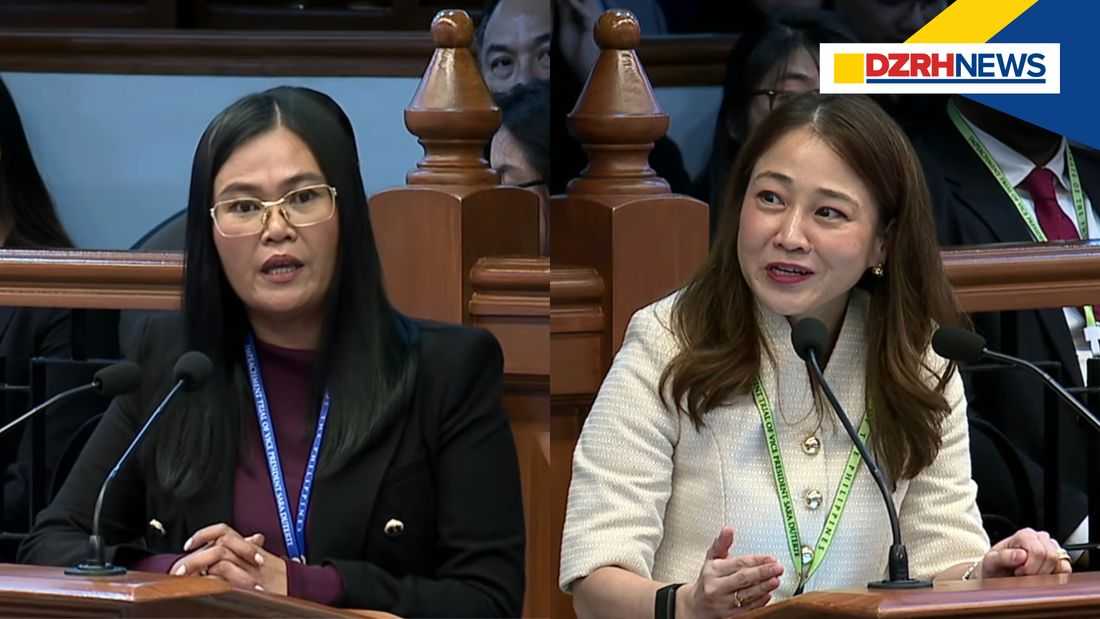
The defense panel in the impeachment trial of Vice President Sara Duterte maintained that it is not yet obligated to disclose its position on the identities of individuals listed in acknowledgment receipts allegedly linked to the disbursement of confidential funds.
The statement came after private prosecutor Atty. Mae Divinagracia questioned why the defense could still not say whether the names appearing in the acknowledgment receipts were genuine identities or aliases.
Divinagracia argued that the defense had already been given opportunities during the filing of its answer and the pre-trial proceedings to clarify its position, saying the prosecution had built its case based on the issues defined during pre-trial.
“With all due respect, Your Honor, it's already a tad too late for the defense, Your Honor, to be adopting the position that these are aliases,” Divinagracia said.
She stressed that the prosecution was also entitled to due process and should know the defense’s theory of the case.
“Since the beginning of these proceedings, the defense has been invoking due process as if it were a magic wand that could straitjacket the prosecution. Now, Your Honor, it's not only the defense who has the right to due process. Even the prosecution is entitled to due process,” she said.
Divinagracia added that the trial had already reached what she described as the “11th hour,” yet the prosecution still had no certainty about the defense’s position on the names.
“Wala pa rin, Your Honor, kasiguruhan. Ano ba yung position, Your Honor?” she said.
Defense counsel Atty. Sheila Sison, however, pushed back against the prosecution’s demand, emphasizing that the burden of proof remains with the prosecution and that the defense does not have to present its evidence prematurely.
“I think, Atty., the counsel appears to be interested in finding out about the position of the defense, but she may perhaps have neglected the basic and the most essential idea of a fair trial, and that is for the prosecution to first discharge its burden of proof,” Sison said.
She stressed that the defense could remain silent until the prosecution had sufficiently established its case.
“And until the prosecution hurdles that burden, then the defense may even remain silent,” she added.
Sison further argued that the proceedings were still at the prosecution’s stage, noting that the Senate impeachment court was only on the second article of the prosecution’s presentation.
“It is also basic and it is apparent and manifest before everyone, before this court, at sa ating mga manonood na hindi pa itong panahon para sa depensa,” Sison said.
“In fact, nasa pangalawang article pa lang po tayo ng prosecution,” she added.
Sison maintained that the defense should not be compelled to reveal whether it would present evidence or what its position would be on the disputed names before the proper stage of the proceedings.
“Siguro kung gusto natin ng fair trial, kailangang makita muna ng taong-bayan ang ebidensya na sinasabi ng prosecution at hindi nagre-reklamo sa kung ano ang hindi na ipapakita ng depensa precisely because this is not yet the time of the defense to present its evidence or whether we will even present evidence if the proper time comes,” Sison said.
She concluded that the defense’s decision would depend on what the prosecution ultimately establishes during the trial.
“Depende sa maipapakita ng prosekusyon,” Sison said.
The exchange came as the Senate impeachment court continued examining evidence concerning the alleged irregularities surrounding confidential funds of the Office of the Vice President and the Department of Education (DepEd).
The defense has continued to challenge the prosecution’s evidence and its interpretation of the names appearing in the acknowledgment receipts, while the prosecution has argued that it must be allowed to establish its allegations before the defense responds.
