
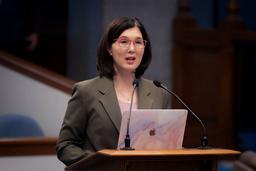
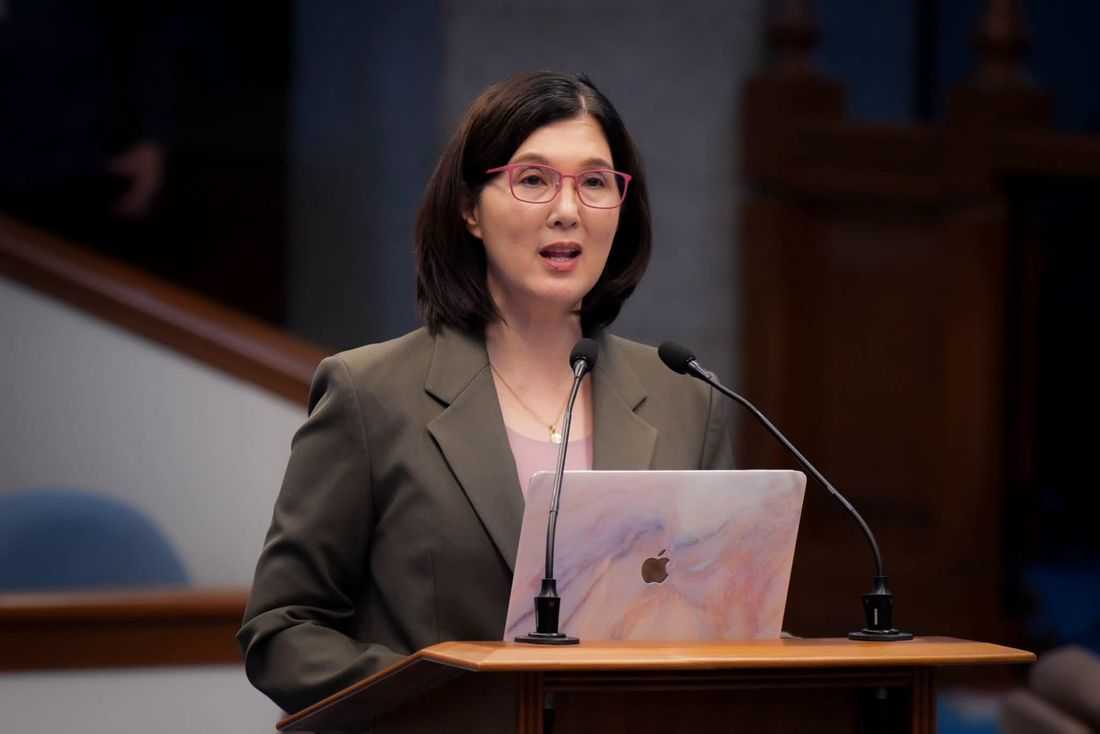
Senator Pia Cayetano said on Tuesday that it is difficult to take pride in the Philippines’ status as an upper-middle-income country, as it does not reflect reality for the majority of Filipinos.
During her privilege speech, Cayetano began with an illustration of what the status would appear to the ordinary Filipino: happy, healthy families eating nutritious food three times a day and with access to a good healthcare system. Parents who are able to come home at a reasonable hour, unimpeded by traffic jams; workers who are able to go home to their provinces on the holidays without the trip completely draining their earnings on air fares. Roads with sidewalks, bike lanes; cities with parks where children can play sports, and so on.
“Pero napakahirap ipagmalaki at ipaliwanag na tayo ay isang upper-middle-income country kung hindi naman ito nararamdaman ng karamihan ng mga Pilipino,” she said.
The senator explained that the country’s new status was simply an indication of the gross national income, rather than individual household incomes. To attain an upper-middle income status, this must stand between $4,496 or ₱277,000 to $13,900 or ₱860,000.
“So ito po ay national economic size. Hindi po ito individual income. So when you look at the vast majority that are minimum wage earners, less than minimum wage earners, informal sector, hindi naman sila nandidito sa income bracket na ito. This is merely an income classification, it is a way of grouping economies according to average income. It does not reflect the struggles of ordinary Filipinos,” she emphasized.
Cayetano cited a Social Weather Stations (SWS) survey conducted this year, which revealed that 52 percent of families identify as poor, and 42 percent consider their families as food poor.
In the first quarter of 2026, she said that 23.2 percent of Filipino families experienced involuntary hunger.
Filipinos who experience this reality would feel unseen and unheard by the celebration of this status, she said.
“When we celebrate our status as an upper-middle income country, ang pakiramdam ng tao, ‘You do not see us. You do not hear us… Hindi niyo ramdam ang hirap namin,’” the senator said.
“Kaya ako po, never po ako nagse-celebrate. Kahit ilang taon ko na ‘yan naririnig na malapit na tayo mag-upper-middle income. It does not translate to a better life for most of the Filipinos,” she added.
Although securing an upper-middle-income status may afford the country better loans and other perks, she said foreign investors have a long list of criteria before investing in a country.
Cayetano added that, according to the Philippine Statistics Authority (PSA), only 10 of the 17 Sustainable Development Goals (SDGs) have shown some progress. However, eight of these 10 SDGs are not progressing fast enough to meet the 2030 target, and two of the SDGs are “moving backwards”—namely the areas of good health and wellbeing (SDG 3) and sustainable cities (SDG 11).
“So mukhang fail po tayo sa sustainable development goals,” she said.
Earlier this month, President Ferdinand Marcos Jr. welcomed the World Bank’s classification, a milestone he said affirms the economic policies the government has been implementing.
“After nearly four decades as a lower-middle-income country since 1987, this milestone affirms that the economic policies we have pursued over the past four years have been effective,” Marcos said in a video message following his state visit to Canada.
