
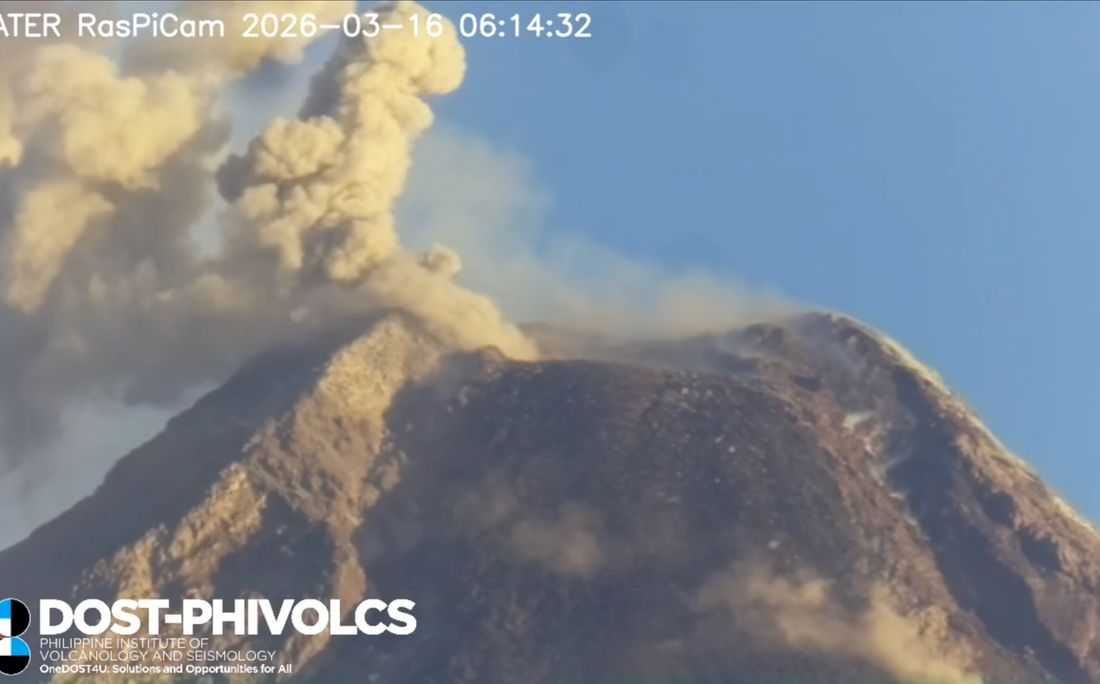
The Philippine Institute of Volcanology and Seismology (PHIVOLCS) reported a short-lived lava fountain at Mayon Volcano early Monday as the volcano’s effusive eruption reached its 70th consecutive day.
According to PHIVOLCS, time-lapse footage captured lava fountaining from 3:32 a.m. to 7:10 a.m. on March 16, 2026, marking a brief but notable increase in eruptive activity.
“Effusive eruption at Mayon Volcano continues for the 70th consecutive day, generating incandescent lava flows, pyroclastic density currents (PDC) or ‘uson,’ and rockfalls,” PHIVOLCS said.
The agency said the ongoing effusive eruption continues to generate incandescent lava flows, pyroclastic density currents (PDCs) locally known as “uson,” and rockfalls along the volcano’s slopes.
Monitoring data released Monday showed 539 volcanic earthquakes and 290 rockfall events recorded around the volcano within the monitoring period. The agency also detected seven pyroclastic density current signals, along with ongoing lava effusion and lava flow activity.
PHIVOLCS reported that lava had reached 3.8 kilometers along the Basud Gully, 3.2 kilometers along the Bonga Gully, and 1.3 kilometers along the Mi-isi Gully.
The volcano also exhibited intermittent and weak strombolian activity accompanied by occasional short-lived lava fountaining. Meanwhile, sulfur dioxide emissions from the crater averaged 1,220 tons per day on March 16.
A moderate plume rising about 200 meters above the crater was observed drifting westward.
State volcanologists said Alert Level 3, which indicates a high level of volcanic unrest, remains in effect over Mayon. PHIVOLCS reiterated that entry into the six-kilometer Permanent Danger Zone (PDZ) is strictly prohibited due to the risk of sudden explosions, lava flows, and pyroclastic density currents.
