
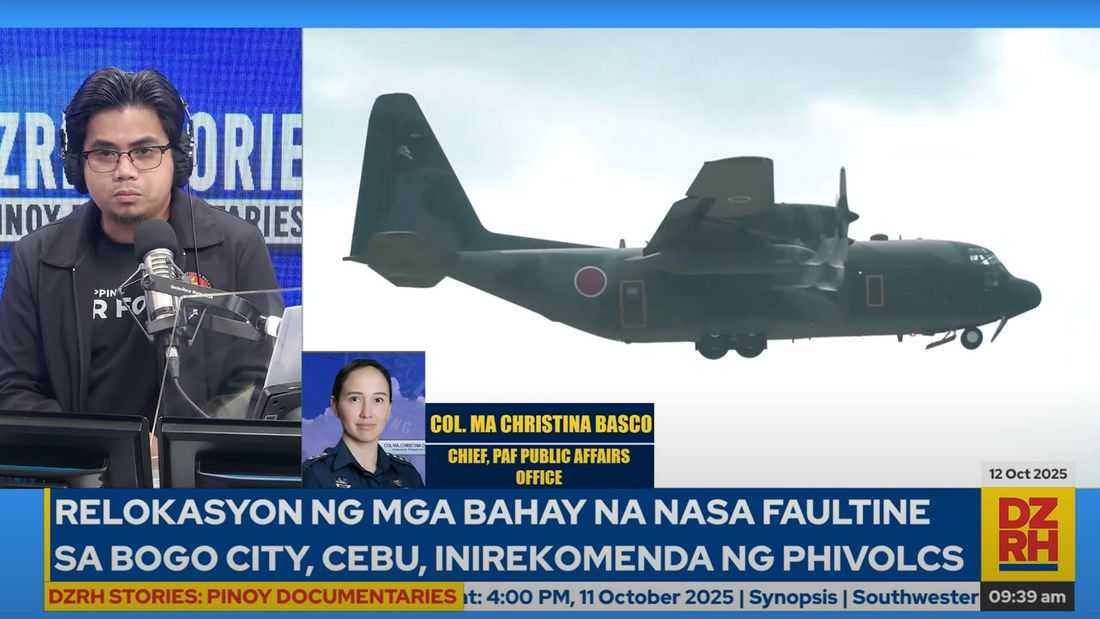
The Philippine Air Force (PAF) and Japan Air Self-Defense Force (JASDF) recently held their annual bilateral humanitarian exercise, “Doshin-Bayanihan,” coinciding with the aftermath of the recent 6.9-magnitude earthquake in Cebu and the 7.4 tremor that struck Davao Oriental.
In an exclusive interview on DZRH Stories: Pinoy Documentaries, Colonel Ma. Christina Basco, Chief of the PAF Public Affairs Office, said the exercise—scheduled from October 7 to 10—was designed as a humanitarian assistance and disaster response (HADR) training.
However, it turned into an actual response opportunity when strong earthquakes hit the country during the same period.
“Itong Doshin-Bayanihan, annually scheduled ito between Philippine Air Force and Japan Air Self Defense Force. The nature of this activity is humanitarian assistance and disaster response. Nagkataon na pagdating nila, naka-schedule na and nangyari itong earthquake sa atin,” said Col. Basco.
Immediate Response Operations
Basco explained that the PAF’s prepositioned aircraft across the country allowed for immediate deployment following the quake in Davao Oriental.
“Noong nagkaroon ng earthquake nitong recently sa Davao, immediately nag-take off ‘yong ating Black Hawk tapos nag-conduct sila ng RDANA o Rapid Damage Assessment and Needs Analysis,” she said.
“Inikutan nila ‘yong area para makita ‘yong scope, ‘yong grabe ng nasalanta ng earthquake para maplano natin maigi kung ano ‘yong ipa-prioritize na tulong.”
The RDANA operation was also joined by Department of Public Works and Highways (DPWH) Secretary Vince Dizon, who personally assessed the affected areas alongside the Air Force team.
National Security and Preparedness
Col. Basco also discussed the strict maintenance and inspection procedures for PAF aircraft to ensure flight safety and readiness.
“Meron tayong periodic inspection… Before it takes off, ine-ensure natin na meron tayong mga kino-conduct na 360 visual inspection. Hindi biro na itetake off natin itong eroplano nating pang-himpapawid na hindi siya maayos, so kailangan talaga top-notch condition siya,” she emphasized.
She added that the PAF utilizes a range of aircraft—including C-130s, C-295s, Black Hawks, and Sikorsky —for transport, relief operations, and air evacuation of supplies. These are deployed alternately to prevent wear and ensure consistent operational readiness.
While the Japanese air force concluded their scheduled stay as planned, Basco noted that their participation strengthened bilateral cooperation and disaster preparedness capabilities.
For organizations and groups seeking to extend donations or coordinate logistics support, Basco advised contacting the Office of Civil Defense (OCD) for proper facilitation.
Col. Basco also assured the public that the country’s defense assets remain actively engaged in monitoring Philippine territory, including the West Philippine Sea, while separate air units focus on relief and rescue missions in disaster-hit regions.
“Hindi natin pinapabayaan ang ating mandato,” she affirmed, underscoring the PAF’s dual role in both national defense and humanitarian service.
