
MANILA, Philippines – The Philippines and the European Union (EU) announced that it has reached a “substantial agreement” on a Free Trade Agreement (FTA), that is expected to deepen bilateral trade and investment ties between the two states, the EU announced in its statement released on Tuesday.
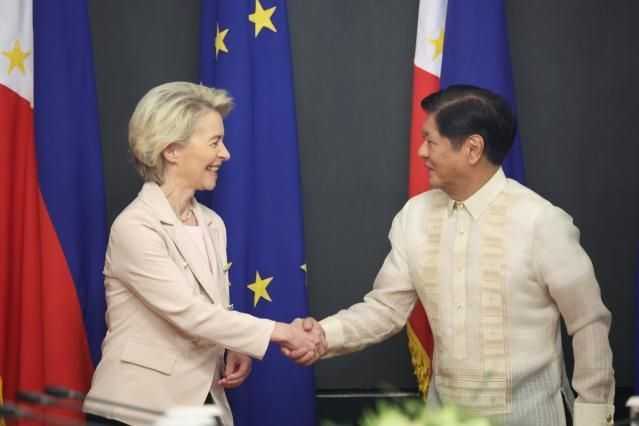
In a readout released by the Delegation of the European Union to the Philippines, it stated that EU President Ursula von der Leyen spoke today with President Ferdinand R. Marcos Jr. of the Philippines, as the EU and the Philippines are about to conclude talks on a Free Trade Agreement. This comes just three years after President von der Leyen's visit to Manila in 2023, when the two leaders agreed to relaunch the negotiations.
According to the EU, President von der Leyen welcomed the positive outcome and thanked the negotiating teams for their hard work and commitment, led on the EU side by Commissioner for Trade and Economic Security Maroš Šefčovič.
“The mutually beneficial agreement should bring tangible benefits, including new opportunities for businesses, more investment and more jobs,” the readout stated.
“It will also support shared priorities on sustainable development and the clean and digital transitions. Given the challenging geopolitical and geoeconomic context, the two leaders also underlined the importance of working with likeminded partners across the world to ensure open, fair and predictable trade,” the readout added.
President von der Leyen congratulated President Marcos on the Philippines' chairmanship of ASEAN. She reaffirmed the EU's commitment to concluding similar ambitious free trade agreements across the ASEAN region. She also noted that this deal is an important signal ahead of step next year's 50th anniversary of EU-ASEAN relations. Von der Leyen looks forward to returning to the Philippines in 2027 to sign the FTA.
On regional security, von der Leyen expressed the EU's solidarity with the Philippines in the face of aggressive maritime claims and reaffirmed the EU's continued support.
In a separate joint statement, the EU and the Philippines announced the breakthrough after a video call between European Commissioner for Trade and Economic Security Maroš Šefčovič and Philippine Secretary of Trade and Industry Ma. Cristina A. Roque, setting the deal on a clear path towards its formal conclusion in the coming months.
Both welcomed the historic outcome, which will deepen bilateral trade and investment ties, making them more diversified and resilient, the statement read.
The agreement also sends a clear signal of reinforced engagement between the EU and the Philippines, anchored in their common interest in an open, inclusive, and rules-based international order in the current volatile context.
According to the statement, in practical terms, both sides highlighted that the FTA will deliver: new opportunities for businesses, including MSMEs, as well as for farmers, manufacturers, and consumers on both sides; stronger, more diversified supply chains, critical at a moment when resilience has become a strategic priority; fair rules and real predictability, underpinned by a shared commitment to a more secure and stable global economy.
Secretary Roque and Commissioner Šefčovič noted that this is a forward-looking partnership, built on trust and mutual benefit and have instructed their negotiating teams to finalize the agreement as soon as possible, the statement mentioned.
EU-ABC optimistic on FTA talks
The European business community remains optimistic on the successful conclusion of the FTA, after undergoing six rounds of talks since it resumed in 2024.
In a separate interview, the European Union-Association of Southeast Asian Nations Business Council (EU-ABC) expressed optimism and said the progress of the negotiation is “excellent.”
“Progress is excellent, and we are extremely hopeful that the announcement that the talks are concluded will be imminent,” EU-ABC Executive Director Christopher Humphrey told a small group of journalists on Monday.
Humphrey also said that aside from reducing tariffs, European businesses need non-tariff barriers reduced on both sides.
“Reducing tariffs is the easy part. It's the easy part of any FTA negotiation. We need to see non-tariff barriers (NTBs) reduced on both sides. And the EU has NTBs as well,” Humphrey told DZRH and Manila Standard during an interview via video conferencing.
“So, we need to see them reduced on both sides,” Humphrey emphasized.
He also added that improved market access would be vital as well, and some harmonization or moves towards harmonizing.
“Standards would also be very much welcome, along with things like geographical indicators and IP protection. They're key components of EU trade agreements and they'd be very much welcomed by EU businesses,” Humphrey stated.
In a separate statement released on the EU-ABC website, Humphrey welcomed the agreement and congratulated the negotiating teams “for achieving this significant milestone with determination and strong political will.”
He called the developments a “major win” for both European and Philippine businesses, that will help provide the stable, predictable and rules-based trading environment that businesses increasingly value amid heightened global uncertainty, and open up significant new commercial opportunities through improved market access, lower trade barriers and greater regulatory certainty.
The EU-ASEAN Business Council is the primary voice for European business within the ASEAN region, according to its official website.
Humphrey is in the Philippines to attend the 12th ASEAN-EU Business Summit in Manila on Tuesday, September 22.
