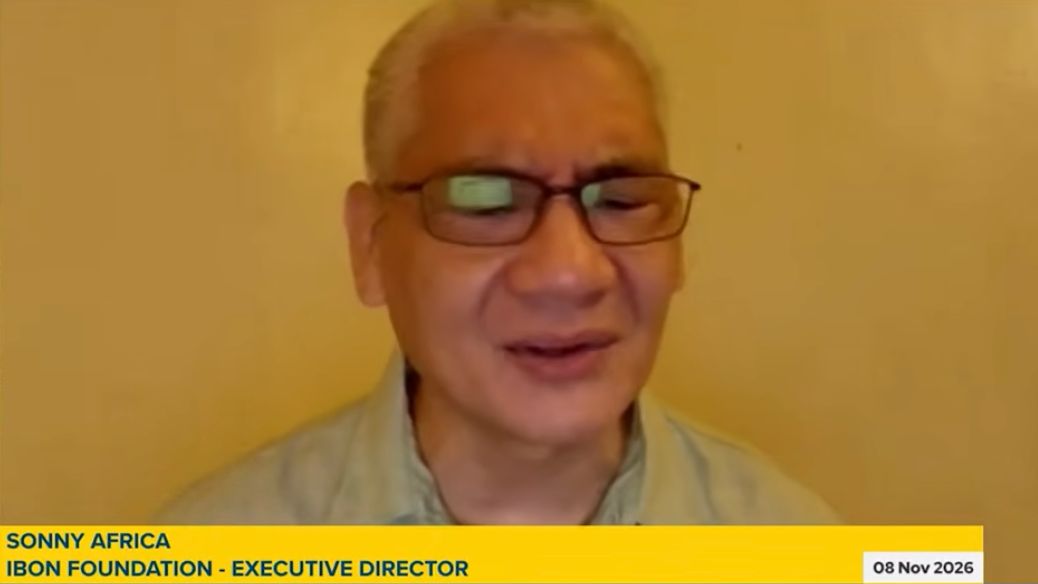
The independent research group IBON Foundation strongly criticized the government’s official poverty threshold of ₱96 per person per day, describing the methodology used by the Philippine Statistics Authority (PSA) to compute the figure as “abnormal” and outdated.
During an interview on DZRH’s Saturday Rapido Hataw Balita program, IBON Foundation Executive Director Sonny Africa explained that the government’s computation relies on an obsolete methodology from 2011 that focuses almost exclusively on the barest food requirements while failing to account for actual living costs.
"Maling-mali 'yung metodolohiya... Ang ginagawa lang niya, 'yung pinakamatipid na kailangan sa pagkain para sa isang minimum nutritional energy standard. Wala siyang paglilista kung magkano ba 'yung iba pang gastusin—'yung kuryente, tubig, pamasahe, upa, pag-aaral, edukasyon, kalusugan, at iba pa."
Africa criticized how non-food expenditures are factored into the threshold, explaining that after computing a minimal "food bundle" based on the cheapest available commodities in rural areas, the government simply adds a fixed 43% multiplier to cover every other basic necessity.
"Ang ginagawa nila, 'yung sobrang tinipid na food requirement, dinadagdagan ng 43%... Sinasabi nila, 'yang dagdag na 43% sapat na para doon sa lahat ng iba: pag-aaral, damit, pagpapagamot, pamasahe, komunikasyon, upa, kuryente, at tubig. So medyo abnormal 'yun kasi hindi naman gano'n 'yung gastusin sa totoong mundo."
Distorting Poverty Statistics
Africa cautioned that maintaining unrealistically low poverty metrics allows policymakers to mask the true extent of economic hardship facing ordinary Filipinos. By relying on an artificially low standard, official reporting can claim progress while millions remain trapped in poverty.
"Kung itatago ng gobyerno 'yung totoong bilang ng mahirap—'yung lawak at 'yung ilalim ng kahirapan—sabihin nila, 'Oh, nabawasan ang kahirapan.'... Pero hindi totoo, dumadami 'yung bilang ng mahirap. Niloloko nila hindi lang 'yung publiko, mas malala siguro, niloloko nila sarili nila."
He contrasted the government's low poverty figures with self-rated poverty surveys, noting that survey data from the Social Weather Stations (SWS) revealed around 55% of Filipino families—equivalent to nearly 18 million households—consider themselves poor. In contrast, official statistics suggest only about 6% of families are poor under the ₱96-per-day standard.
When asked what a realistic standard should be, Africa pointed out that government policy should aspire to provide a decent quality of life rather than calculating the absolute bare minimum needed for survival.
Based on IBON's updated Family Living Wage computations, a family of five requires significantly more than the current threshold to live decently:
"Sa aming huling pagkwenta, 'yung nakabubuhay na kita para sa isang pamilya ng lima, dapat hindi bababa sa ₱200 kada Pilipino sa isang araw... More or less, dapat ₱1,000 a day o ₱1,300 a day kung 5-day work week."
Africa stressed that the government must address the root causes of economic vulnerability—such as low-quality informal employment, high youth unemployment, and underinvestment in local agriculture and manufacturing—rather than relying on artificially depressed poverty lines.