

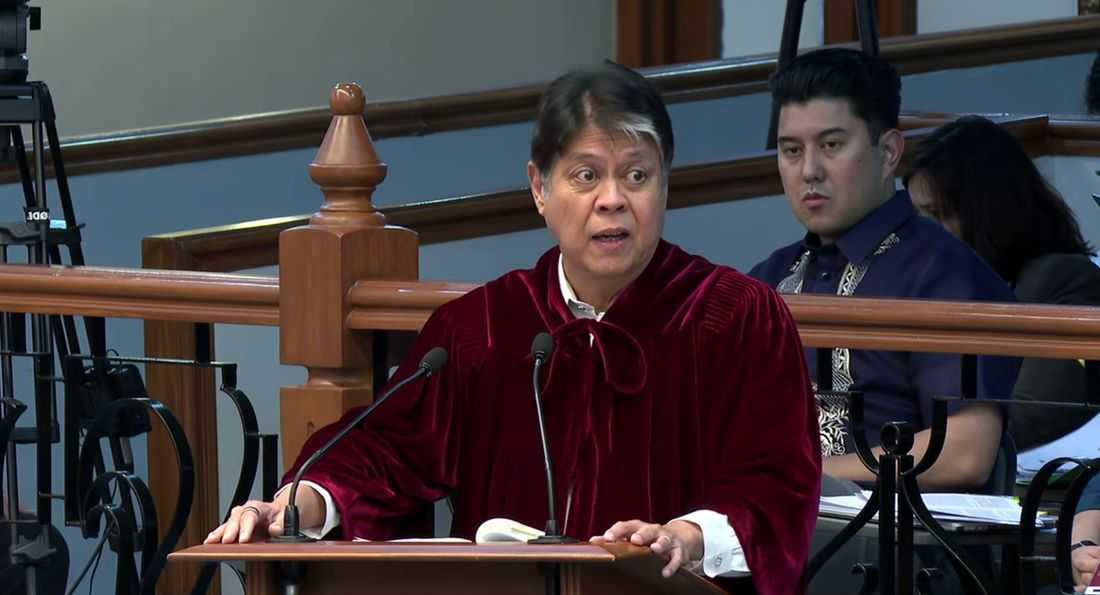
Senator-judge Francis “Kiko” Pangilinan on Monday backed Presiding Officer Francis “Chiz” Escudero’s ruling permitting the Anti-Money Laundering Council (AMLC) to submit subpoenaed records in Vice President Sara Duterte’s impeachment trial, saying it is consistent with existing law and Supreme Court jurisprudence.
Pangilinan, who was one of the two primary sponsors of the Anti-Money Laundering Act (AMLA) in 2001 along with Senator-judge Imee Marcos, said the law was intended to harmonize the Bank Secrecy Act with the AMLA.
Pangilinan said the legislative intent behind the AMLA showed that confidentiality provisions were intended to cover financial institutions and not the AMLC itself.
Citing the Supreme Court’s ruling in Republic v. Sandiganbayan, Pangilinan said the legislative debates supported Escudero’s interpretation of the law.
“The intention of legislation then, when we defended this measure in 2001, was for the absolute prohibition, or the confidentiality rather, was for the covered institutions and not for the AMLA,” he said during the 33rd day of the impeachment trial.
Pangilinan also argued that it would be inconsistent to allow a private bank to be compelled to disclose bank records in an impeachment trial while preventing the government agency tasked with addressing money laundering and other financial crimes from presenting its own transaction records.
“And so, if I may add, it would be absurd that a private bank in an impeachment case, trial, can be compelled to divulge bank records while the AMLA, which is the government entity that is supposed to address issues of criminal activity and money laundering, cannot be compelled to present AMLA transactions and records,” Pangilinan said.
“With respect to legislative intent, with respect to the ruling of the Supreme Court on Republic versus Sandiganbayan, maliwanag, that the ruling of the Chair is four square behind jurisprudence and the law,” he added.
Marcos, however, maintained her objection to the ruling, saying the AMLA contains no specific exception allowing the disclosure of its records in impeachment proceedings.
“I too was a primary author of the AMLA and we were very, very clear about what needed to be in it,” Marcos said.
“There is no mention of an exception for impeachment proceedings,” she added, arguing that such an exception is found only in the bank secrecy law, under Section 2, where bank secrecy and general financial confidentiality yield to the constitutional powers of an impeachment court.
Marcos said senators must exercise caution in interpreting the law and follow both its intent and specific provisions.
“Like Senator [Pia] Cayetano, it behooves us indeed to be very, very careful and prudent with following not only the spirit but a technical and specific letter of the law,” she said.
