
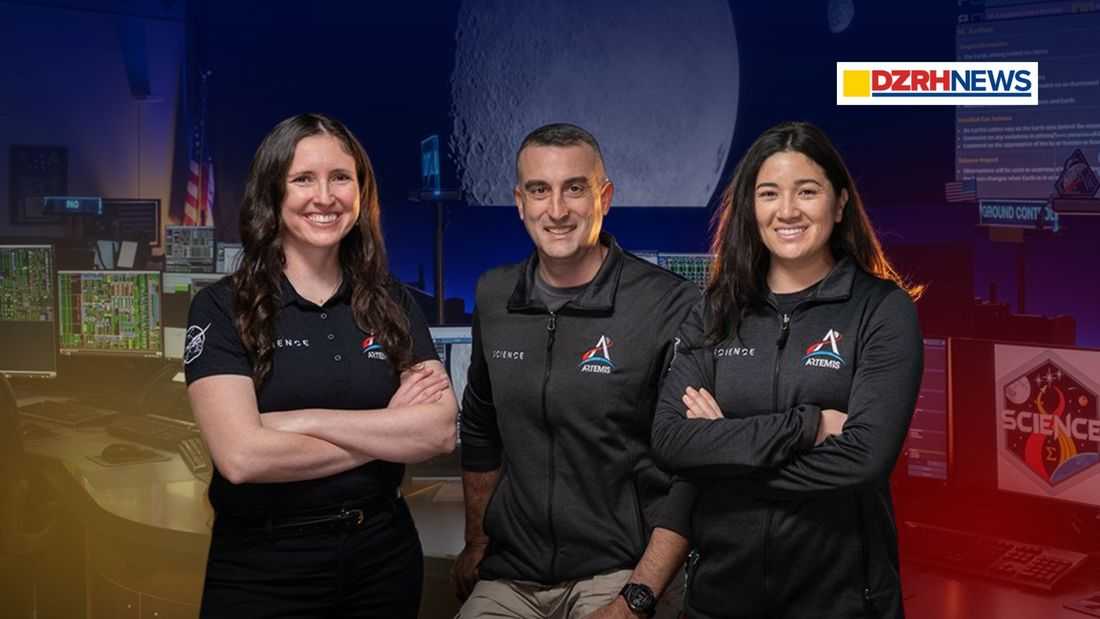
Scientists from the National Aeronautics and Space Administration (NASA) have been certified as the first dedicated “science officers” for the upcoming Artemis II, marking a major shift in how scientific research is integrated into human spaceflight.
Kelsey Young of NASA Goddard Space Flight Center, along with Trevor Graff and Angela Garcia from NASA Johnson Space Center, will serve in the new role inside Mission Control. Unlike previous missions dating back to the Apollo program, Artemis II introduces a front-room science position responsible for overseeing lunar geology and research objectives in real time.
The science officer will coordinate with flight controllers handling communications, propulsion, and life support, ensuring scientific goals are embedded directly into mission execution. This reflects decades of evolution in spaceflight operations, where science teams were previously confined to “back room” support roles.
After months of simulations, geology fieldwork, and astronaut training—including exercises in lunar-like terrains in Iceland—the team is now prepared to guide astronauts during the mission’s planned lunar flyby. During this phase, astronauts aboard the Orion spacecraft will photograph the Moon and record detailed observations, acting as real-time scientific observers.
Experts on Earth will analyze incoming data from dedicated science rooms at Johnson Space Center, providing immediate feedback to Mission Control. Researchers say combining human observation with modern scientific knowledge could reveal new insights into lunar surface features, including subtle variations in color, texture, and geology that automated systems may miss.
Although Artemis II will not land on the Moon, it is expected to play a critical role in refining scientific operations for future missions under the Artemis program. The mission will test workflows, communication systems, and decision-making processes that will shape how astronauts conduct research during upcoming lunar landings.
NASA officials say the integration of science officers highlights a renewed focus on exploration as both a technical and scientific endeavor—bringing humanity one step closer to deeper understanding of Earth’s nearest celestial neighbor.
