
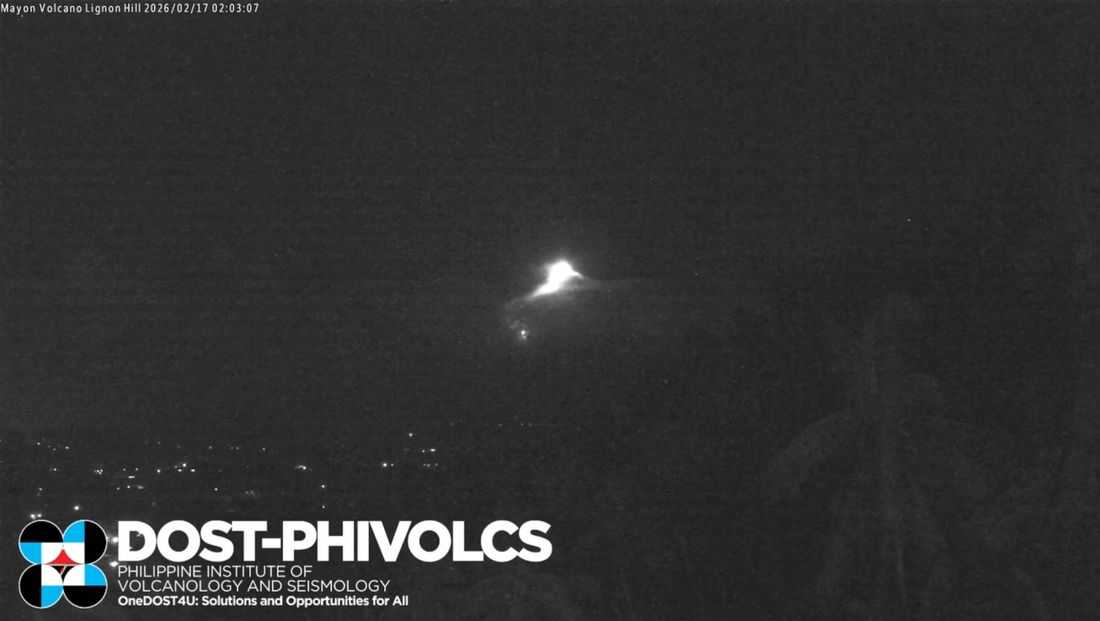
A lava effusion, collapse, and minor strombolian activity were recorded at the Mayon Volcano summit in the early hours of Tuesday, February 17, according to the Philippine Institute of Volcanology and Seismology (PHIVOLCS).
The volcano, which recorded activity at 2:00 a.m. and 2:21 a.m., and again at 2:30 a.m., has been experiencing effusive eruptions with minor strombolian activity for 43 days now, which has generated incandescent lava flows, pyroclastic density currents (PDC) or “uson,” and rockfall.
“Lava flows have reached radial distances from the crater of ~3.8km in the Basud (east), ~1.6km in the Bonga (southeast), and ~1.3km in the Mi-isi Gullies (south) as of 05 February 2026,” said PHIVOLCS.
Mayon Volcano is currently at Alert Level 3. Entry into the 6-kilometer Permanent Danger Zone is prohibited.
Lava effusion is the non-explosive, steady outflow of molten rock, while collapse refers to a substantial portion of the volcano structure sliding down the mountain in a landslide.
Meanwhile, strombolian activity indicates a series of short, separate explosions wherein magma is ejected tens to hundreds of meters above the crater.
