
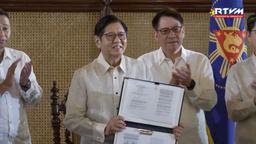

President Ferdinand Marcos Jr. on Friday signed into law amendments to the Universal Access to Quality Tertiary Education Act (UAQTEA), expanding government financial assistance to more students, particularly those from poor and underserved families.
Marcos signed on Friday the amendments to Republic Act 10931 during a ceremony at Malacañan Palace attended by members of Congress, Cabinet officials and other government representatives.
The law provides free tuition and other school fees for students enrolled in state universities and colleges, local universities and colleges, and state-run technical-vocational institutions. It also provides financial assistance through the Tertiary Education Subsidy and the Tulong Dunong Program.
The amendments expand the coverage of the Tertiary Education Subsidy and include additional support for disadvantaged and underserved students, including qualified beneficiaries of the government's Pantawid Pamilyang Pilipino Program, or 4Ps.
The expanded assistance will also cover more education-related expenses, such as costs that can prevent students from completing their studies despite receiving free tuition.
“Free tuition removed a major barrier to tertiary education, but families still face the cost of books, transportation, daily expenses, and other requirements that can prevent students and trainees from completing their studies,” Marcos said during the signing ceremony.
Marcos said the government must ensure that students not only gain access to public colleges, universities and technical-vocational institutions but also receive support to complete their education and training.
The amendments also allow poor and deserving students enrolled in priority programs who are not covered by existing grants to receive government assistance at qualified private higher education and technical-vocational institutions.
“This Act reflects what our Bagong Pilipinas should always be: a country where every young Filipino, especially the most disadvantaged, has an equal chance at a quality tertiary education,” Marcos said.
He said the measure seeks to bring the country closer to a future where every Filipino family has at least one child who completes a bachelor's degree or a technical-vocational education and training program.
