
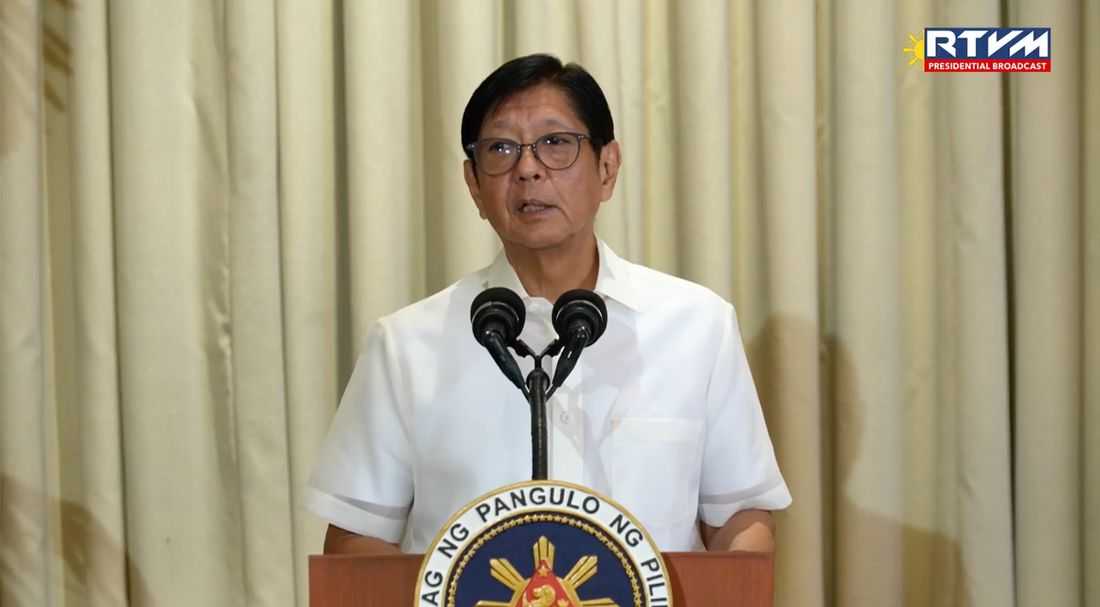
President Ferdinand 'Bongbong' Marcos Jr. on Tuesday assured the public that the Philippines has sufficient oil supply for up to 60 days despite escalating tensions in the Middle East.
In a press briefing, Marcos said the government is closely monitoring developments in the region and is prepared to implement measures to cushion the impact of possible supply disruptions and price spikes.
“Let me assure everyone that we have sufficient supply of oil. Mayroon tayong stockpile that are approximately 50 to 60 days in terms of gasoline, fuel oil, and kerosene,” Marcos said.
He added that aside from local inventories, existing foreign suppliers also maintain their own stockpiles, which could serve as additional sources if needed.
“We’re okay for that period of time,” the President said, seeking to allay public fears over a potential shortage of oil-derived products, including fuel and fertilizer.
According to the President, the country’s current fuel stockpile are as follows:
- Diesel: 50.5 days
- Fuel oil: 51.5 days
- Gasoline: 51.5 days
- Kerosene: 67.5 days
- Jet fuel A1: 58 days
- Liquefied Petroleum Gas (LPG): 29 days
Marcos noted, however, that countries holding their own oil stockpiles may limit exports to protect domestic reserves while the crisis continues.
While supply remains stable for now, Marcos acknowledged that global oil prices are expected to rise as the conflict unfolds.
“We have already seen the reaction on the oil products, on sa krudo, sa gasolina, sa LPG, at nararamdaman na kaagad. And that’s expected,” he said.
The President said the government has drawn up several scenarios, citing estimates that the conflict could last four to five weeks. He expressed hope that hostilities would ease sooner, allowing oil production and global commerce to normalize.
Tax cuts, subsidies under consideration
Marcos said the government is considering interventions and reducing excise tax on petroleum products if Dubai crude reaches between $80 and $90 per barrel for at least two months.
Among the measures being studied are targeted fuel subsidies for the transport, agriculture, and fisheries sectors. The government may tap funds from existing programs such as Pantawid Pasada, as well as subsidies for farmers and fisherfolk.
“We are also trying to look at the possibility of easing the transport cost burden to workers, for the traveling public, providing maybe no-fare bus rides along major routes, and maybe to hold fares down on public transport facilities,” he said.
“And of course, we are now going to look for whatever subsidies we will need to provide so that hindi naman masyadong maramdaman ng working public ang pangyayaring ito,” Marcos noted.
Marcos added that he will consult leaders of the House of Representatives and the Senate on granting the President authority to temporarily reduce excise taxes on petroleum products if Dubai crude exceeds $80 per barrel.
“This is one tool that we will have to have. So I will discuss it with the leadership of Congress to see if it is going to be an emergency measure, it is not going to be a permanent measure. It will be something that we will dispose of as soon as the crisis is over,” he said.
Marcos said the government is also coordinating with oil companies to stagger any price increases to avoid sudden spikes that could burden consumers.
Meanwhile, the Department of Energy (DOE) earlier warned of another round of fuel price hikes following recent increases.
Oil firms implemented adjustments effective 6:00 a.m. Tuesday, raising gasoline prices by P1.90 per liter, kerosene by P1.50 per liter, and diesel by P1.20 per liter.
The DOE’s Oil Industry Management Bureau said local fuel prices could increase by as much as P2 per liter in the coming weeks due to the escalating conflict involving the United States, Israel, and Iran.
While no final figures have been confirmed, authorities said they are bracing for continued volatility in global oil markets as geopolitical tensions persist.
