
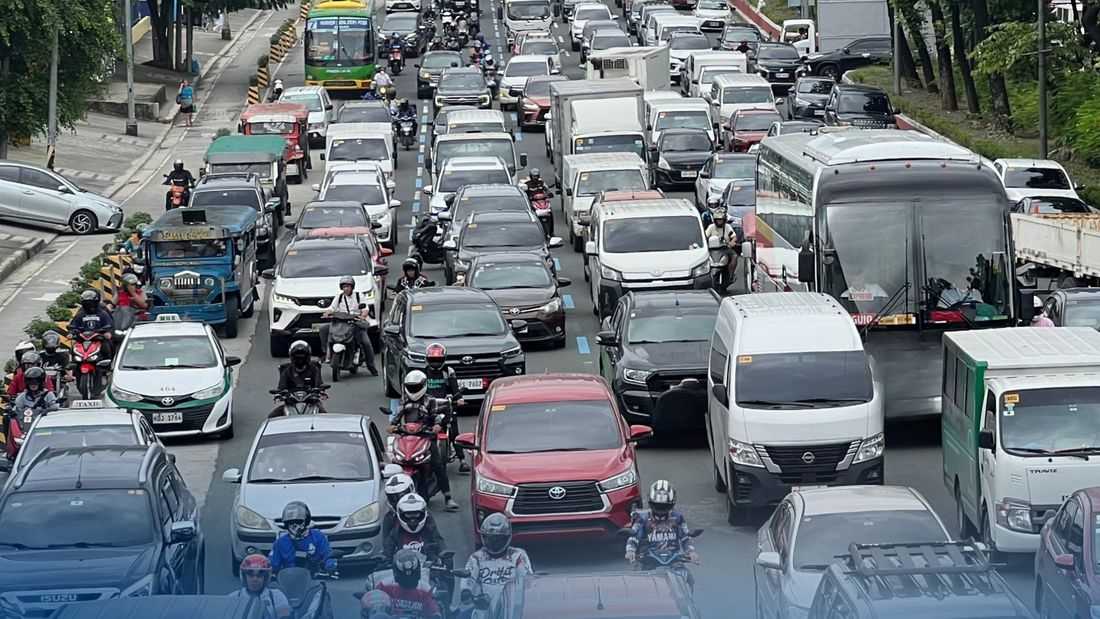
The Land Transportation Franchising and Regulatory Board (LTFRB) will begin implementing its service contracting program on April 15, with an initial rollout covering selected routes nationwide, an official said Monday.
Speaking on DZRH’s “Dos Por Dos,” LTFRB Chairperson Vigor Mendoza II said the program is ready for implementation and will be expanded across regions, subject to budget constraints.
“Kompleto na po detalye dito. It will start on April 15. Tapos i-scale up namin buong Pilipinas na ito," he said.
Mendoza said the initial funding of about P800 billion will cover more than 800 routes in Metro Manila, nearby provinces, and other parts of the country, benefiting around 47,000 public utility vehicles (PUVs), including jeepneys, Asian utility vehicles and buses.
“Halos every region meron tayong ruta na covered ng service contracting. But due to the limited budget, 800 billion initially, Hindi natin nakaya yung lahat ng ruta," Mendoza explained.
Under the scheme, drivers will continue to collect fares from passengers but will also receive a government subsidy based on the distance they travel.
“For traditional jeepneys and AUVs, the subsidy is P30 per kilometer, while modern jeepneys will receive P40 per kilometer. Buses operating along the EDSA Busway will get P1 per kilometer, and those outside the busway will receive about P82 to P83 per kilometer,” Mendoza said.
He explained that the program follows a “net service” model, where operators retain fare revenues but are supplemented with per-kilometer subsidies to offset fuel and operational costs.
Based on LTFRB’s financial model, a traditional jeepney driver earning about P5,000 daily from roughly 300 passengers would see gross collections reduced to P4,000 due to a mandated 20% fare discount for commuters under the program.
Fuel consumption, estimated at 30 liters per day, would translate to about P3,600 in government subsidy, assuming an average efficiency of four kilometers per liter and a P30-per-kilometer incentive.
Even with reduced fare income, Mendoza said drivers could still take home earnings after expenses. With an additional subsidy of up to P3,000 for traveling 100 kilometers per day, drivers would have enough to cover boundary payments to operators, typically ranging from P700 to P1,000, and still bring home income.
“Even if we lower the assumed gross income to P4,000, there will still be take-home pay for drivers and enough to pay the boundary,” he said.
Mendoza further affirmed that they are confident that the daily earnings of their drivers will not fall below P1,000, unless there are disruptions like vehicle breakdowns.
The program also mandates a 20% fare discount for passengers across participating routes.
To ensure compliance, Mendoza said the LTFRB will implement dual monitoring systems. Participating vehicles will be required to install GPS devices, partly subsidized through an additional P0.50 per kilometer allocation. Manual inspections will also be conducted in areas with weak signal coverage.
Applications for the program will be conducted online, with operators required to submit basic details such as franchise case numbers, vehicle plate numbers, and GPS providers.
Approved units will display markers indicating participation in the program, along with route-specific fare matrixes reflecting the discounted rates.
Mendoza said the LTFRB is also seeking an additional P5 billion in supplemental funding through the Department of Transportation to sustain and expand the initiative.
“Gaya po the announcement din ng DOTr ni Sec. Banoy (Giovanni Lopez), nag-request na po kami ng supplemental budget of five billion para sa ganoon matuloy-tuloy po natin itong programang ito," he said.
He noted that not all vehicles on a given route may be enrolled in the program, meaning participating and non-participating units could operate simultaneously.
