
Philippine officials are seeking clearance from the United States to allow potential oil procurement from Russia, as lawmakers pressed for faster action to address supply constraints and rising economic risks during a session of the PROTECT Committee on Monday, April 13.
Foreign Affairs Secretary Ma. Theresa Lazaro said negotiations with U.S. authorities remain ongoing following the conclusion of initial talks on April 12 between the Philippine Embassy in Washington and both the U.S. State Department and Treasury Department.
“The reason is because there were sanctions imposed by the United Nations, and only the United States can lift or exempt those sanctions,” Lazaro told lawmakers, adding that Manila is now working toward securing a possible six-month arrangement for exemptions.
She emphasized that discussions are not “across the board” but focused on specific engagements with U.S. agencies.
During the hearing, Sen. Imee Marcos questioned why the Philippines could not directly engage Russia through its ambassador in Manila, noting that other countries in Southeast Asia have already pursued similar arrangements.
“Even the Americans have relented on the sanctions imposed on Russia, tayo takot na takot pa rin. Bakit ganun?” Marcos said, raising concerns about the country’s continued reliance on Washington.
Lazaro responded that exemptions or lifting of sanctions must come from the United States, given their role in enforcing restrictions tied to the global financial system following the Russian invasion of Ukraine.
She added that while Manila maintains “very good relations” with Moscow, bypassing established diplomatic channels could expose the country to potential sanctions.
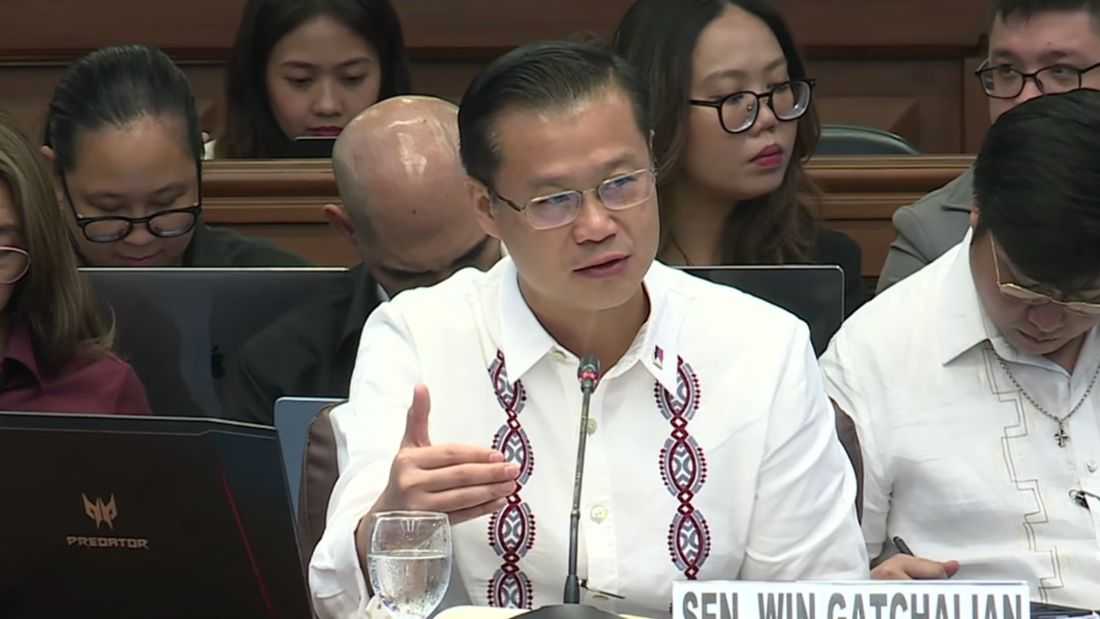
Sen. Win Gatchalian underscored the urgency of securing fuel supply, questioning the need for prior U.S. approval if the Philippines itself did not impose sanctions on Russia.
“Bakit nga kailangan magpaalam sa U.S.? Because time is of the essence eh. And we need the oil yesterday,” Gatchalian said.
“Kung magpapaalam pa tayo, that will obviously delay the delivery of oil supply, so bakit pa kailangan magpaalam?” The senator added, suggesting that the Philippine National Oil Company (PNOC) could proceed with government-to-government purchases if supply is available.
Energy Secretary Sharon Garin noted that private firms are reluctant to transact without U.S. clearance due to fears of possible repercussions, while government transactions would still follow diplomatic protocols.
“For example, for our private companies, they don’t want to buy unless it is lifted kasi baka sila habulin daw ng U.S. They wanted the clearance before they buy,” Garin said.
Lazaro cautioned that proceeding without exemptions could risk triggering broader financial sanctions, as restrictions are intertwined with the global economic system.
Sen. Risa Hontiveros said the situation highlights the need for long-term reforms to reduce vulnerability to global economic pressures, including strengthening cooperation among so-called “middle powers.”
Despite differing views, officials agreed to pursue all available options. Lazaro said the government would continue engaging both Washington and Moscow “as soon as possible.”
Gatchalian reiterated that the priority is securing immediate supply, whether from Russia or other producers such as Venezuela, warning that delays could worsen inflation and economic hardship.
“Our interest now is to secure as much oil supply as possible, regardless of where it will come from,” he said.
Meanwhile, the Department of Foreign Affairs (DFA) reported that airspace conditions in parts of the Middle East remain partially open as of April 12, with some commercial flights to and from Manila suspended or operating at reduced capacity.
Several countries, including Jordan, Saudi Arabia and Turkey, remain fully open, while Kuwait has temporarily halted operations.
Lazaro also said Iran has assured the Philippines of safe and unimpeded passage for Philippine-flagged vessels and seafarers through the Strait of Hormuz, a key global energy shipping route.
