
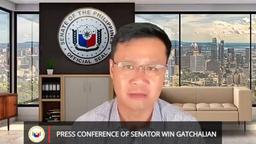

Sen. Sherwin Gatchalian on Wednesday floated the possibility of a "Bayanihan 3" or a supplemental budget to combat soaring fuel prices, warning that a "worst-case scenario" for government intervention could reach ₱400 billion.
In an online press conference, Gatchalian addressed the widening impact of inflation on the middle class and minimum wage earners.
He outlined a range of legislative options, including the suspension of excise taxes and a massive expansion of fuel subsidies, to prevent more Filipinos from falling below the poverty line.
"If we reach that point, we might be looking at a supplemental budget or even a Bayanihan 3," Gatchalian said.
He noted that targeted fuel subsidies, such as the Pantawid Pasada program, could cost between ₱7.6 billion and ₱61 billion depending on the severity of the price hikes.
While government social amelioration programs traditionally focus on those living in poverty, Gatchalian emphasized that the middle class is also reeling from current economic pressures.
He identified the suspension of excise taxes on fuel as the most direct method to provide relief across all income brackets, though he remained skeptical about a similar suspension of Value Added Tax.
Gatchalian described VAT as a complex system that remains difficult to dismantle without unintended consequences.
He noted that while some oil industry leaders have proposed removing VAT upon importation to streamline the process, the Bureau of Internal Revenue (BIR) must first determine if such a move would actually benefit consumers.
The senator also expressed concern that without the standard tax structure, businesses might simply fold the costs back into the retail price or spread the burden to other essential goods.
The senator’s recommendations are currently tied to Senate Resolution 45, which mandates the creation of a National Contingency Plan. Because of the "time element" and the difficulty of gathering formal signatures during the current period, Gatchalian released the preliminary findings to provide immediate policy guidance to the executive branch.
“Ang kanyang mandate naman is to recommend and also give their findings on the National Contingency Plan. That's why our first recommendation is to create that National Contingency Plan," he said.
“But in the absence of the National Contingency Plan, nagbigay na kami ng recommendation based on the hearings and based on our findings during the hearings, and also all the submissions sa amin," he added.
The eventual legislative output is expected to take several forms. Gatchalian indicated that the committee is looking at formalizing amendments to the Oil Deregulation Law and drafting the necessary measures for a supplemental budget.
He stressed that the goal is to protect the "near poor" and middle-income earners who are most susceptible to falling into poverty when hit by sudden inflation shocks.
“Ang importante dito yung pag tinamaan ka ng inflation shock, kaagad bababa yung income mo or pwede kang pumunta sa poverty segment,” Gatchalian said. "That is why we have to study this very carefully."
