
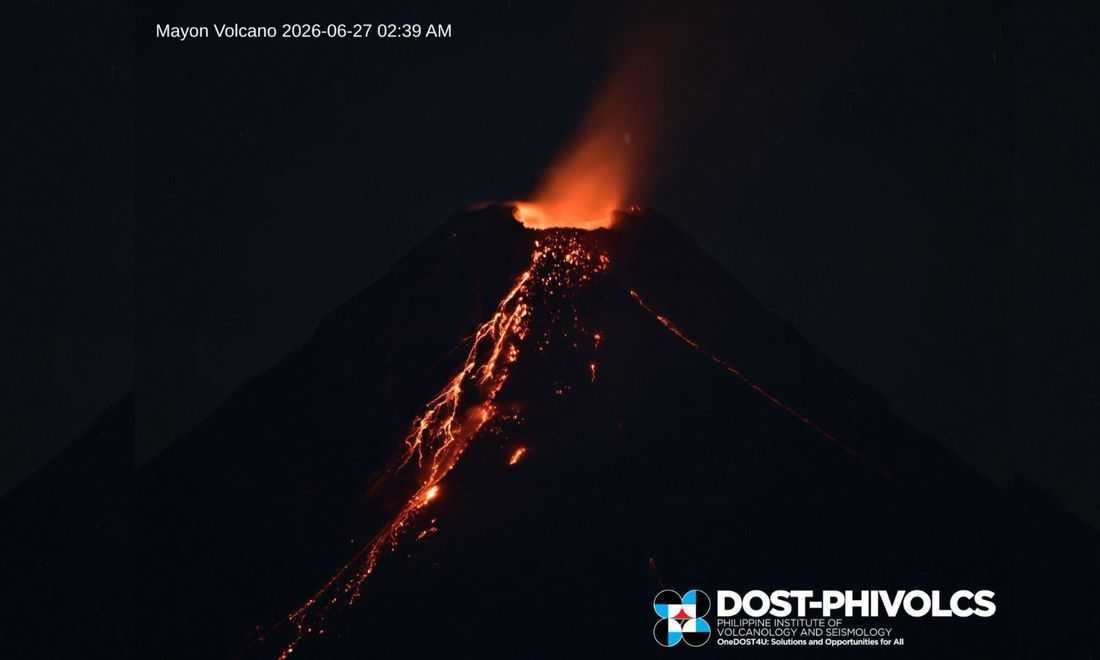
Effusive eruption activity at Mayon Volcano continued for its 173rd consecutive day, with persistent lava effusion from the summit crater, pyroclastic density currents (PDC) or “uson,” and frequent rockfalls, the Philippine Institute of Volcanology and Seismology (Phivolcs) said Saturday.
Phivolcs reported that time-lapse footage captured by its Quick Response team showed ongoing volcanic activity between 9:41 p.m. and 11:19 p.m. on Friday, and again at 2:39 a.m. and 2:44 a.m. on June 27.
“Effusive eruption at Mayon Volcano continues for its 173rd consecutive day, generating incandescent lava flows, pyroclastic density currents (PDC) or ‘uson’, and rockfalls,” the agency said in its bulletin.
Meanwhile, in its 24-hour monitoring report from 12:00 a.m. Friday to 12:00 a.m. Saturday, Phivolcs recorded 34 volcanic earthquakes, 13 volcanic tremors lasting five to 10 minutes each, and 222 rockfall events.
Lava flows were observed extending down multiple channels, reaching 3.8 kilometers along Basud Gully, 3.2 kilometers along Bonga Gully, and 1.8 kilometers along Mi-isi Gully.
The crater glow remained visible to the naked eye.
The volcano emitted an estimated 2,288 tons of sulfur dioxide gas and produced a plume reaching 1,000 meters above the crater before drifting northeast.
Phivolcs maintained Alert Level 3 over Mayon Volcano, noting that the 6-kilometer Permanent Danger Zone remains strictly off-limits.
The state volcanologists reiterated that Mayon poses multiple hazards, including rockfalls, landslides or avalanches, ballistic fragments, lava flows and lava fountaining, pyroclastic density currents, moderate explosive activity, and lahars during periods of heavy and prolonged rainfall.
