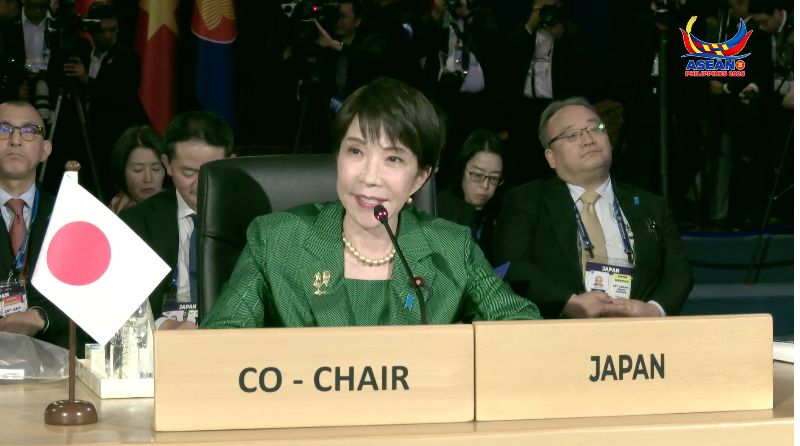
Japanese Prime Minister Sanae Takaichi has proposed the establishment of an 'Asia Oil Security Task Force' to strengthen regional energy security and improve cooperation on oil procurement and stockpiling during emergencies.
In her opening remarks at the fourth Asia Zero-Emission Community (AZEC) Leaders’ Meeting on Tuesday, November 17, Takaichi said the proposed task force would develop rules for the emergency release and transfer of oil supplies among participating countries.
Japan also plans to establish an International Energy Agency (IEA) hub in Tokyo to serve as the task force’s central coordinating body, which Takaichi described as a potential Asian equivalent of the IEA.
“We will create the Asia Oil Security Task Force with the aim of rule-making for emergency release and transfer and establish the IEA hub in Tokyo to serve the core functions of the task force, which we intend to promote as an equivalent of [the] Asian version of the IEA,” she said.
Takaichi also proposed using Japan’s idle oil storage tanks for a regional stockpiling arrangement that would complement a joint stockpiling scheme led by the Philippines.
“I also wish to propose an initiative for cooperation on oil stockpiling in Asia through the use of idle tanks in Japan, which can coordinate with the Philippines-led joint stockpiling scheme,” she added.
The proposed initiatives aim to strengthen the region’s ability to respond to potential disruptions in energy supplies through closer coordination among Asian countries.
Takaichi also called for upgrading the existing AZEC framework into “AZEC 2.0” to strengthen energy resilience through cooperation with the IEA and regional partners.
As part of the broader initiative, Japan will promote biofuels, small modular reactors (SMRs) and next-generation photovoltaic technology to support economic and energy resilience.
She also announced the proposed “Bridge Asia” initiative, which aims to establish a common market for advanced technologies across Asia, a region representing about one-third of the global population.
Meanwhile, Takaichi introduced the “Power Gulf” initiative to strengthen coordination between oil-producing countries in the Middle East and energy-consuming countries in Asia.
She said the initiative would serve as a comprehensive cooperation framework to promote economic and energy resilience in Gulf countries and improve cooperation between producers and consumers.
Takaichi said Japan would serve as a link between oil-producing countries and Asian energy consumers, while also promoting the use of the Joint Crediting Mechanism.
She added that the initiatives under AZEC would help build a more resilient and prosperous region while advancing climate change measures alongside economic growth.