
TAIZ, Yemen/DUBAI, Sept 14 (Reuters) - Yemen's Iran-aligned Houthis launched a new attack on Saudi Arabia on Monday and Gulf Arab states postponed planned talks with Iran, raising concerns the Middle East conflict could spread further and threaten global oil supplies.
The Houthis on Monday said they fired dozens of missiles and drones at a military airbase in Khamis Mushait in southern Saudi Arabia, targeting aircraft hangars, radar systems, runways and ammunition depots in retaliation for Saudi airstrikes in Yemen.
Saudi authorities issued emergency alerts there and in three other southern cities.
The action followed an attack on Saudi Arabia on Friday, which Riyadh blamed on Iran-backed fighters in Iraq. That knocked out the country's east-west pipeline, which allows Gulf oil exports to bypass the blockaded Strait of Hormuz.
Further pressuring global oil supplies, the Houthis have advanced rapidly in Yemen in recent days, capturing territory including Perim Island at the mouth of the Red Sea on Friday.
The renewed Yemen conflict poses another challenge for U.S. President Donald Trump, who faces pressure from Gulf allies to help contain the Houthis but has sought to avoid opening a major new front.
Saudi Arabia has led a coalition battling the Houthis since 2015, but the conflict had largely quietened under a ceasefire in recent years. Fighting reignited this month, with the Houthis pushing back forces aligned with the internationally recognised government.
Three sources have told Reuters that Washington has so far resisted Saudi requests for direct military intervention beyond intelligence support. Trump said over the weekend he had spoken with the crown prince and that the Houthis had also contacted Washington urging it to stay out of the conflict.
Saudi state media reported that Crown Prince Mohammed bin Salman met U.S. regional commander Admiral Brad Cooper in Jeddah on Monday.
The International Organization for Migration estimates 82,000 Yemenis have fled fighting since the start of the month as the Houthis swept into cities, including the historic Red Sea port of Mocha in Yemen last week.
Aisha Muhammad, an elderly woman burning twigs to heat a kettle in government-held territory near Taiz in southwestern Yemen, told Reuters she had left behind two daughters and three sons who had been unable to escape.
"They can't even go out to the market to get food and drinking water. They are being blocked and shot at, so they are trapped inside their homes," she said. "They cannot reach us, and we cannot return to them. This is a trial from God."
HOPES FOR DIPLOMACY FADE
Oman had been due to host a meeting on Monday with Iran and Gulf states to discuss negotiations aimed at reopening the Strait of Hormuz, which before the war carried 20% of the world's oil exports. But Oman announced overnight that the meeting had been postponed. Iran said the postponement was at the request of Saudi Arabia.
Trump repeated his frequent claim that Iran was eager to make a deal quickly, but Mohsen Rezaei, secretary of Iran's Supreme National Security Council, called the president's message a distraction, saying on X, "No talks until Iran's conditions are met."
Crude oil prices rose more than 4% on Monday before settling about 1% higher.
Traders said a prolonged shutdown of the Saudi pipeline could cut off as much as 4% of global oil supply. Riyadh has not said when operations might resume.
CONFLICTING REPORTS ON DAMAGED TANKER
Underscoring the volatility of shipping through the region, conflicting reports circulated about how and when an oil tanker was damaged.
Without giving a date, Iran's Revolutionary Guard Corps said the Panamanian-flagged oil tanker El Gaia was hit by sea mines as it passed through a prohibited zone south of the Strait of Hormuz, Iran's Fars news agency reported on Monday.
But the U.S. military's Central Command immediately said the report was false and the tanker was "struck by an Iranian missile last month and rendered inoperable."
The United Nations' International Maritime Organization reported El Gaia was damaged on Saturday, but did not say how, and that two seafarers were missing.
The British navy-affiliated agency UK Maritime Trade Operations reported that a vessel it did not identify was struck by a projectile within the strait on Saturday, adding that a fire broke out and the crew was being evacuated.
Reuters could not immediately contact the ship's owners in Dubai to verify any of the accounts.
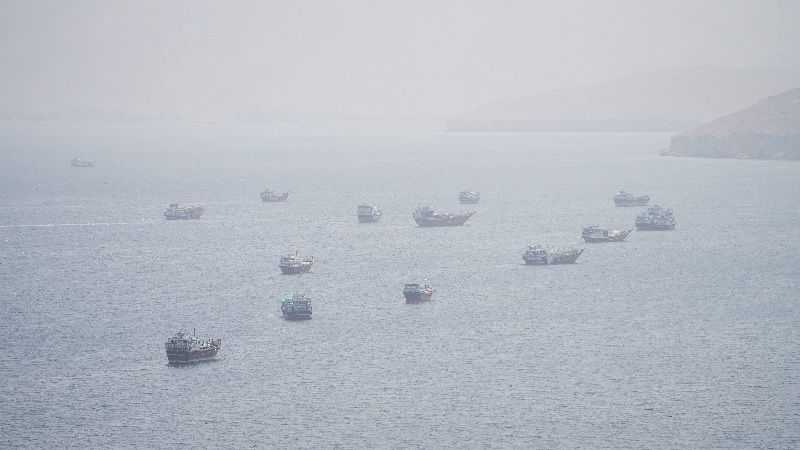
The world's most important oil shipping lane has been mostly shut down since the war began on February 28 as Iran has threatened vessels that transit the waterway without its authority.
El Gaia had been on a list of 77 ships that Iran said had violated its operating protocols in Hormuz, warning that they could face fines, detention or confiscation on future transits.
"The IRGC Navy firmly declares that the Strait of Hormuz is closed and still under our smart control," the Revolutionary Guards said in the statement.
(Reporting by Reuters in Taiz, Jana Choukeir, Eman Abouhassira, Elwelly Elwely, Nayera Abdallah in Dubai, Yasmine Ghania and Yomna Ehab in Cairo, Daphne Psaledakis in Washington, and Lisa Baertlein in Los Angeles; Writing by Peter Graff, Ros Russell and Daniel Trotta; Editing by Alex Richardson and Cynthia Osterman)
