

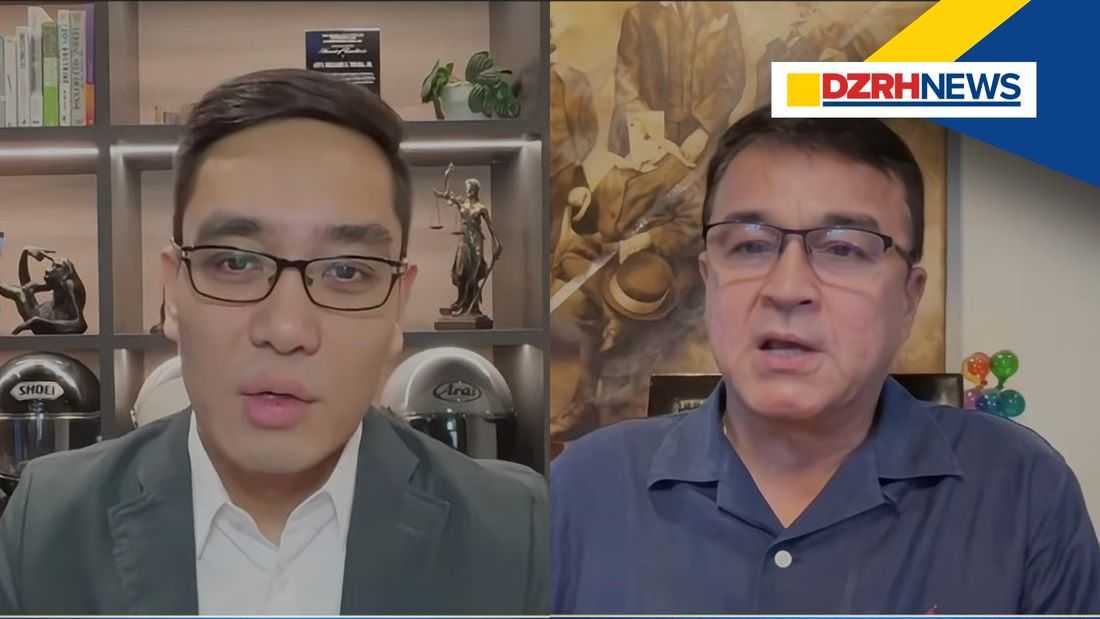
The House prosecution panel on Friday defended the evidentiary value of the affidavit executed by Arturo Lascañas, maintaining that it remains a relevant piece of evidence in the impeachment trial of Vice President Sara Duterte despite questions over its admissibility and the absence of notarization.
Speaking during a press conference, House private prosecutor Atty. Benjamin Tolosa Jr. said a document does not automatically lose its legal effect simply because it is not notarized, stressing that the impeachment court must evaluate the entirety of the evidence presented.
"The fact that it is not notarized does not immediately mean that it has no legal effect. It should not be treated as mere trash," Tolosa said.
He explained that Lascañas had offered explanations for the inconsistencies between his previous and later statements, noting that changes in a witness's testimony should be assessed on a case-by-case basis rather than automatically dismissed.
Tolosa cited the testimony of NBI Director Melvin Matibag, who said investigators must examine the reasons behind a witness's change in statements to determine which version is truthful. He added that Lascañas claimed in his later affidavit that he had previously been coached to deny allegations concerning the Davao Death Squad, although Tolosa emphasized that these were Lascañas' own assertions and formed part of the basis considered by the National Bureau of Investigation (NBI) made its findings.
Meanwhile, House prosecution team adviser and former Representative Ace Barbers described Lascañas' affidavit as an "admission against interest," arguing that the witness acknowledged his own alleged participation in incidents linked to accusations against then-Davao City Mayor Sara Duterte.
Barbers said Lascañas' later affidavit included allegations that there were orders from then-Mayor Sara Duterte related to kidnapping and alleged extrajudicial killings. He argued that the affidavit gained significance because Lascañas admitted his own alleged liability and later decided to disclose what he claimed was the truth.
"This is an admission against interest because he admitted that he also had responsibility. He said his conscience compelled him to reveal what happened," Barbers said.
He stressed that the affidavit should not be viewed in isolation, noting that it is only one component of the evidence presented by the NBI. According to Barbers, it is ultimately the impeachment court that will determine the affidavit's admissibility, credibility, and evidentiary weight after weighing all the evidence submitted by both the prosecution and the defense.
