
The House of Representatives has approved the proposed Basic Education Voucher Assistance Act, a measure that seeks to expand the government's education voucher program to cover the entire K–12 system in a bid to address classroom shortages and provide more schooling options for Filipino students.
Under the proposed measure, students enrolled in overcrowded public schools may opt to transfer to accredited private schools participating in the voucher program, with DepEd providing financial assistance through the expanded voucher system.
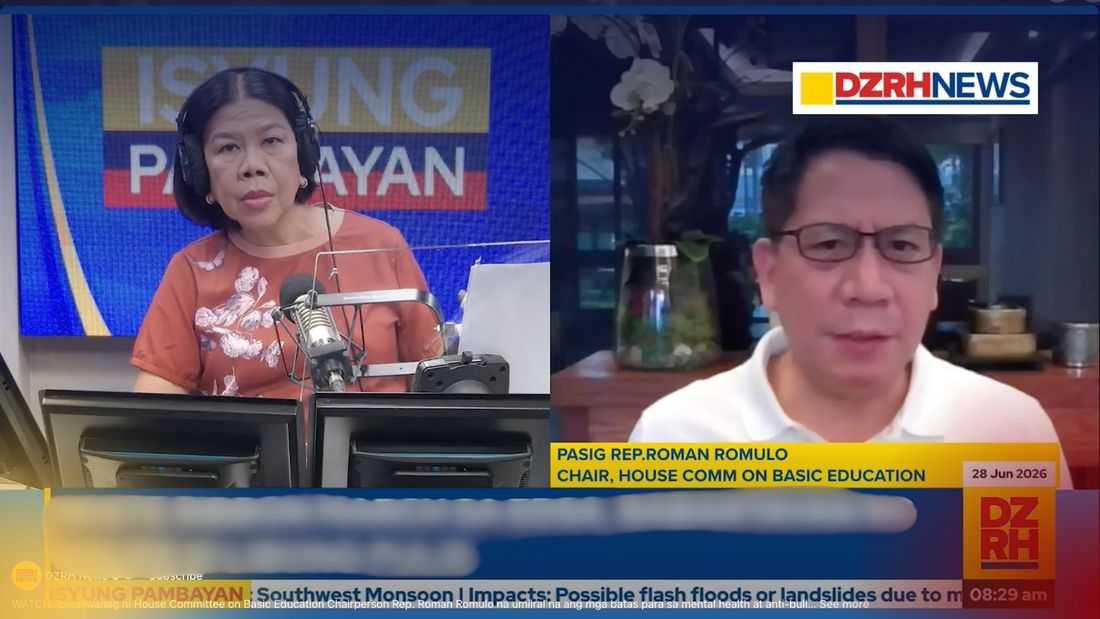
In an exclusive interview on DZRH's Isyung Pambayan, House Committee on Basic Education Chairperson Rep. Roman Romulo explained that the current Expanded Government Assistance to Students and Teachers in Private Education (E-GASTPE) program only covers students from Grades 7 to 10, while a separate voucher program is available for senior high school (Grades 11 and 12). However, learners from kindergarten to Grade 6 are currently excluded from the voucher system.
According to Romulo, the newly approved measure expands the existing voucher program to include the entire K–12 education cycle, allowing the Department of Education (DepEd) to provide vouchers to eligible students from kindergarten through senior high school.
"Sa kasalukuyan, ang coverage lang ng E-GASTPE program ay Grade 7 to 10 at 11 to 12 may voucher program. Pero ang K to 6 hindi kasama. Dito sa bagong panukalang batas na ito, ini-expand na natin ang E-GASTPE o voucher system. Ngayon, buong K-12, pwede na magkaroon ng voucher system ang ating Department of Education," Romulo said.
The lawmaker said the measure is intended to help decongest overcrowded public schools, many of which continue to face high student-to-classroom and student-to-teacher ratios, as well as multi-shift class schedules.
Romulo noted that the largest number of learners in the country's basic education system belongs to the Kindergarten to Grade 6 level, making the expansion of the voucher program a significant step toward addressing congestion in public schools.
He added that while the proposal is not the sole solution to the country's education challenges, it could help alleviate the severe shortage of classrooms nationwide.
According to DepEd estimates cited by Romulo, the country currently faces a classroom shortage of approximately 145,000 to 165,000 classrooms, excluding those temporarily unavailable due to retrofitting and rehabilitation.
"Maaaring hindi naman ito ang only solution, pero makakatulong ito sa shortage of classrooms natin. Sabi ng DepEd, more or less 145,000 hanggang 165,000 ang classroom shortage. Hindi pa kasama diyan ang mga dine-retrofit taon-taon," he said.
"Kung merong quality system na private school na magpa-participate sa voucher system nila, ay pwedeng magka-option ngayon ang mga students sa DepEd na lumipat sa isang pribadong paaralan na accredited na quality education ng DepEd," Romulo added.
The proposed Basic Education Voucher Assistance Act is expected to strengthen educational access, maximize the use of existing private school capacity, and help ease pressure on the country's overcrowded public school system while expanding learning opportunities for Filipino students.
