
The government formally launched the Harmonized National Contingency Plan for earthquakes on Thursday morning, coinciding with the conduct of the 2nd Quarter Nationwide Earthquake Drill (NSED) held across the country.
In a Damdaming Bayan report by RH Edniel Parrosa, at exactly 9:00 a.m., officials pressed the ceremonial button at the headquarters of the Office of Civil Defense (OCD) in Camp Aguinaldo, signaling the start of the 2026 simultaneous nationwide earthquake drill.
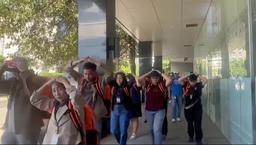
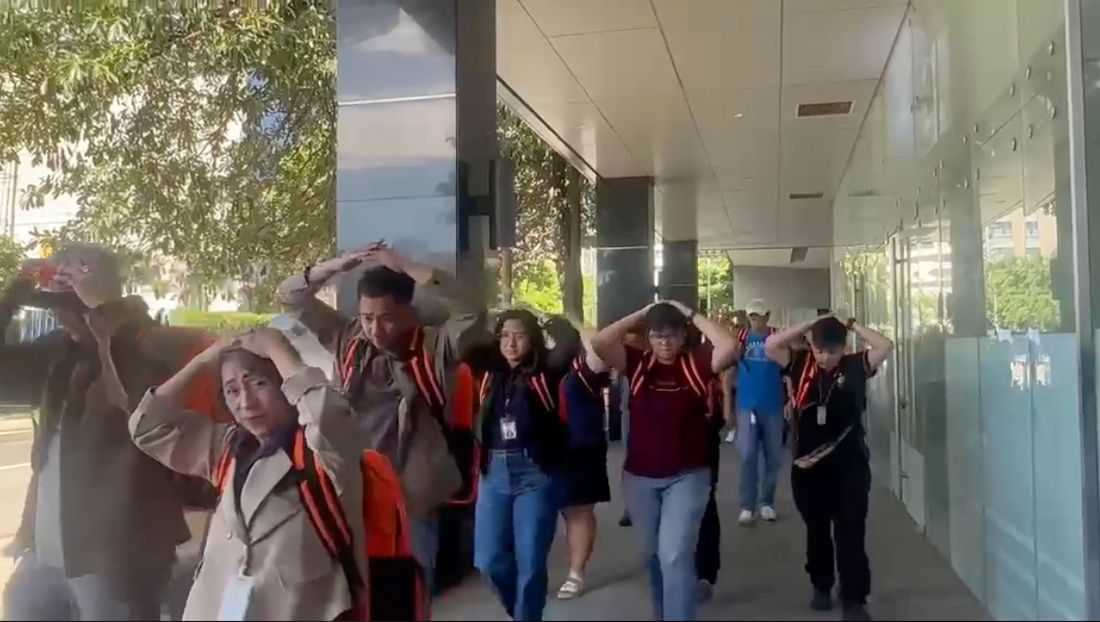
Offices of the government nationwide simultaneously performed the “duck, cover, and hold” procedure, as part of the regularly scheduled four-times-a-year earthquake preparedness exercise.
The drill comes just over a week after a magnitude 7.8 earthquake struck parts of southern Mindanao, which renewed calls for strengthened preparedness and coordination among disaster response agencies.
According to the Office of Civil Defense, this quarter’s exercise highlighted preparedness for “The Big One,” a projected magnitude 7.2 earthquake scenario along the West Valley Fault, which is expected to severely affect Metro Manila, Central Luzon, and CALABARZON.
Alongside the drill, officials also launched the Harmonized National Contingency Plan aimed at improving coordinated response among affected regions, particularly in densely populated and high-risk areas. The plan emphasizes inter-regional assistance, including rapid deployment of resources between Metro Manila, Central Luzon, and CALABARZON, which are projected to be among the hardest hit in a major West Valley Fault movement.
The exercise also focused on strengthening telecommunications readiness, as well as improving coordination, command-and-control systems, and inter-agency communication during large-scale disasters. Senior officials from the defense and disaster management sectors attended the event, along with representatives from the Department of National Defense and other agencies.
Officials from the Philippine Institute of Volcanology and Seismology, including Director Teresito Bacolcol of PHIVOLCS, were also present.
Bacolcol previously clarified that the West Valley Fault system is not connected to the Cotabato Trench, which was responsible for the strong earthquake recently felt in Sarangani and surrounding areas.
Despite the lack of connection between the two seismic sources, she emphasized the importance of sustained preparedness given the country’s constant exposure to earthquakes.
“It serves as another reminder that earthquakes can occur at any time. These events happen within only a few months of each other. They remind us that the Philippines remains one of the most seismically active countries in the world,” Bacolcol said.
“Earthquakes do not occur according to our schedule. They do not wait for us to be ready. This is precisely why preparedness activities such as the National Simultaneous Earthquake Drill are conducted regularly,” she added.
Duck, cover, and hold
As the government formally launched the nationwide simultaneous earthquake drill, several government employees, agencies, and institutions participated in a coordinated emergency preparedness exercise across the country.
The National Disaster Risk Reduction and Management Council (NDRRMC), through the OCD, emphasized that the nationwide drill goes beyond a simple safety exercise and serves as a full-scale test of the country’s disaster response system.
Officials said the activity is designed to evaluate coordination among national and regional agencies in responding to a strong and potentially destructive earthquake scenario.
Various government offices and institutions took part in the simultaneous drill, including personnel from the National Bureau of Investigation (NBI), who conducted evacuation procedures at their headquarters in Pasay City while carrying emergency “go bags.”
Participants simulated response actions following a hypothetical strong earthquake in General Santos City, underscoring the importance of readiness during large-scale disasters.
Employees from Malacañang, the Office of the Ombudsman, and the Department of Justice (DOJ) also joined the exercise, performing evacuation drills and emergency protocols inside their respective offices.
In Metro Manila, the Metropolitan Manila Development Authority (MMDA) led internal drills that included evacuation procedures, emergency response simulations, and post-drill evaluations conducted by its Public Safety Division.
The MMDA also deployed its Mobile Command Center and operations vehicles equipped with rescue tools, locator devices, and emergency equipment. Officials said the exercise is part of long-term preparations for a possible “Big One” scenario, a projected magnitude 7.2 earthquake that could heavily impact the National Capital Region.
Educational institutions and transport agencies also joined the nationwide activity, including De La Salle University (DLSU) and the Light Rail Manila Corporation (LRMC), which conducted coordinated drills to test evacuation and passenger safety procedures.
The National Irrigation Administration (NIA) also participated from its Quezon City offices, while schools and other public and private institutions across the country carried out simultaneous earthquake response exercises.
