
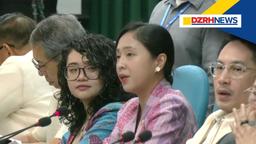

Gabriela Women's Party Rep. Sarah Elago on Thursday renewed calls to reform the country's party-list system, saying it has gradually drifted away from its original purpose of representing marginalized and underrepresented sectors in Congress.
Speaking during the House Committee on Suffrage and Electoral Reforms hearing, Elago presented House Bill No. 6193, or the Genuine Party-list Group and Nominee Act, which seeks to amend the Philippine Party-list System Act by imposing stricter qualifications for party-list groups and their nominees.
Elago said the measure is not new, noting that it was first filed during the 12th Congress by Bayan Muna Party-list and has since been refiled by the Makabayan bloc every Congress.
"The Gabriela Women's Party is here as the principal author of House Bill No. 6193 or the Genuine Party-list and Nominee Act. This is not a new proposal from our representation. It was first filed during the 12th Congress by Bayan Muna Party-list, and it has been refiled by the Makabayan bloc in every Congress," Elago said.
She explained that the Party-list System Act was enacted to provide proportional representation in Congress for national, regional, and sectoral groups, giving marginalized and underrepresented Filipinos a stronger voice in legislation.
While acknowledging that the system has enabled sectors such as women, youth, teachers, urban poor communities, workers, farmers, and fisherfolk to gain representation, Elago argued that the system is increasingly being dominated by political families and wealthy business interests.
"Unti-unti nang nalalayo sa orihinal na napakagandang layunin ang Party-list System Act. Ilang pamilya na nga lang ang nagdodomina sa pambansa at lokal na mga posisyon, pati ba naman sa party-list seats, inaagaw pa sa mga pangkaraniwang mamamayan at batayang sektor," Elago said.
She questioned how party-list representatives could genuinely advocate for marginalized sectors if they have vested business interests.
"Paano natin lubusan na maisusulong ang mga karapatan ng consumers kung ang mga nakaupo ay may-ari din ng mga dambuhalang korporasyon? Paano tunay na aangat ang buhay ng mga maralita kung ang nakikinabang sa kanilang gutom at kawalan ng tirahan ay mismong mga nakaupo sa espasyong dapat naman ay nakareserba para sa kanila?" she said.
Elago also lamented that although party-list seats comprise only 20 percent of the House of Representatives, these positions are allegedly being taken over by political dynasties and influential businessmen.
To address these concerns, Gabriela is proposing stricter registration requirements for party-list organizations and tougher eligibility rules for nominees.
The lawmaker said individuals from political dynasties, government contractors, and incumbent public officials holding other government positions should be barred from becoming party-list nominees.
"Dapat ma-disqualify bilang nominees ang mga galing sa political dynasties, mga contractors, mga kasalukuyang nakaupo sa ibang posisyon sa ating pamahalaan," Elago said.
Elago also cited the concurring and dissenting opinion of former Supreme Court Associate Justice Bienvenido Reyes in Paglaum v. Commission on Elections, emphasizing that the party-list system is rooted in the Constitution's commitment to social justice.
"Far from being merely an electoral reform, the party-list system is one concrete expression of the primacy of social justice in the Constitution," she quoted.
