
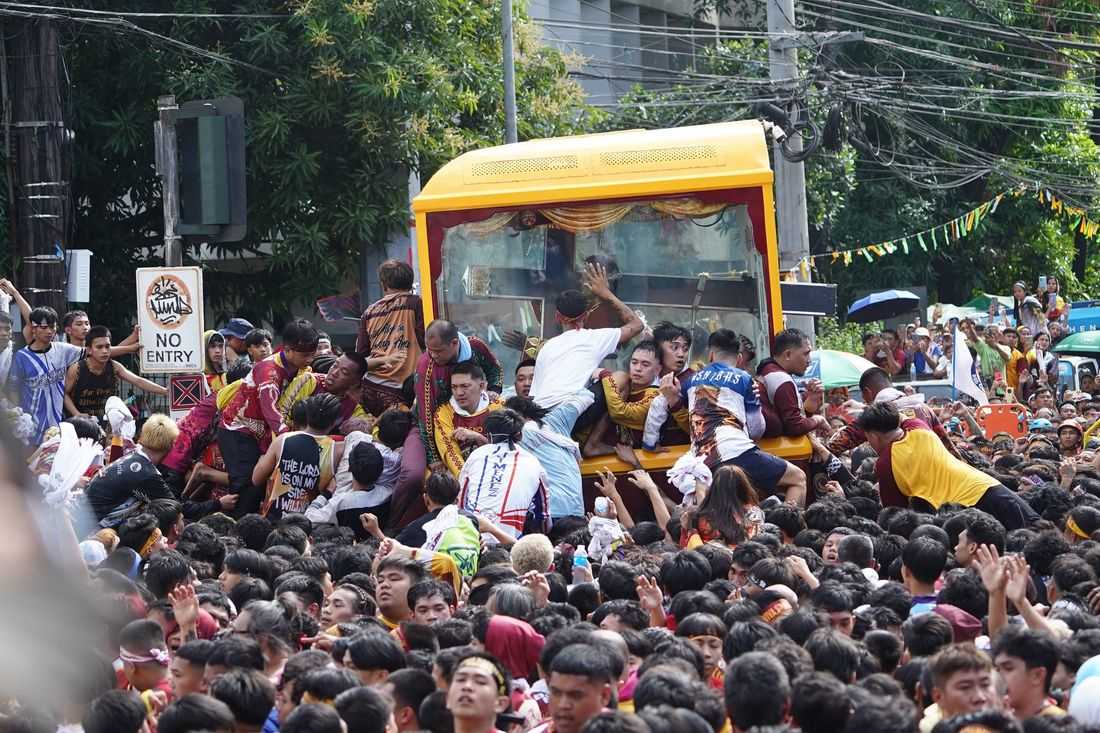
Every January 9, thousands or millions of devotees converge on Quiapo, Manila, for the Traslacion—the annual procession of the Jesus Nazarene. The event, one of the largest religious gatherings in the world, transforms the city’s streets into a sea of devotees united by faith, sacrifice, and hope for miracles.
Despite the heat, the crushing crowds, and the physical strain, devotees return year after year—many walking barefoot as an act of penance and deep devotion. For them, the Traslacion is more than a tradition; it is a profoundly personal expression of faith.
Waving twirled white cloths and chanting “Viva, viva,” devotees line the streets as the centuries-old image of Jesus Christ is solemnly paraded through the heart of Manila, turning the city into a living testament of belief and sacrifice.
The Jesus Nazareno depicts Jesus Christ carrying the cross, an image that resonates strongly with many Filipinos who see their own struggles reflected in Christ’s suffering. Devotees believe that enduring physical hardship during the procession mirrors their spiritual surrender and strengthens their faith.
Many participants offer their walk as thanksgiving for prayers answered, healing received, or guidance during difficult times. Others join in hopes of miracles—health restored, problems resolved, or strength renewed.
Devotees from Malabon arrived at Ayala Bridge to welcome the Jesus Nazareno together with their families, to give thanks and to ask for good health and a stable livelihood.
Meanwhile, Victoriano Delos Santos, a devotee of the Nazareno for 40 years from Cavite, shared that one of the reasons he continues to join the procession is because of his wife, who has cancer.
"Ang aking misis may cancer, under patient up to now...so far, so good mabuti naman ang kalagayan niya," Victorio Delos Santas.
But for two devotees, their prayers were not only for themselves. They also included corrupt officials in their intentions, as shared by some devotees who traveled from as far as Pangasinan and Cagayan.
"Mawala na yung mga lahat ng gumawa ng korapsyon, sana maputol na 'yun," one devote said.
"Sana nga po mategi na silang lahat kasi hindi lang naman po ito sa kapakanan ng bansa natin. Ibalik na lang po nila para maayos po ang Pilipinas," another devoteed added.
#Nazareno2026: Mga korap na opisyal kasama sa panalangin ng ilang deboto | RH 15 @JecelleRicafort, DZRH News#Traslacion2026
— DZRH NEWS (@dzrhnews) January 9, 2026
Facebook Live: https://t.co/3rPzho7FOi
DZRH TV YouTube: https://t.co/dQRrAOplBc
DZRH Website: https://t.co/hoed2qqG8g pic.twitter.com/iX4SANw8Ej
Pahalik: The power of touch and the search for blessings
But before the anticipated Traslacion, among the most important rituals associated with the devotion is the pahalik, where devotees line up to kiss or touch the statue of the Jesus Nazarene every January 7 and 8.
Some wipe the image with towels or handkerchiefs, believing these items carry blessings that can be shared with family members unable to attend.
Andrei Aquino is one such devotee. “Fourteen years na akong pumupunta rito,” he said. “Wala pa yung bunso namin noon.” His attendance spans more than a decade, marking significant moments in his family’s life.
Like many others, Aquino returns not out of obligation, but out of faith strengthened through experience.
Even during the Traslacion itself, devotees struggle to reach the statue or its carriage. Many believe that touching the rope, pulling the image, or briefly placing a hand on the carriage is enough to receive divine grace.
Commitment beyond one day
Amid the chaos of millions moving through the streets, "mamamasan" or volunteer devotees familiar with the route and rituals play a crucial role. They help guide participants, offer assistance to the exhausted, and ensure that fellow devotees remain safe.
Their presence highlights the communal nature of the Traslacion, where devotion is not only personal but collective. Strangers support one another, offering water, helping those who fall, and sharing prayers along the way.
The Traslacion continues to endure despite logistical challenges and safety concerns, drawing even larger crowds each year. Its significance lies not in spectacle, but in sincerity—thousands or millions expressing faith through sacrifice, humility, and perseverance.
In a modern era, the Traslacion remains a powerful reminder of the depth of Filipino Catholic devotion. For its devotees, it is a journey of faith walked barefoot—one prayer, one step, and one hope at a time.
For this year, the National Capital Region Police Office (NCRPO) said it is targeting to shorten the duration of the Traslacion to around 10 to 12 hours, significantly less than the 20-hour procession recorded in 2025.
