
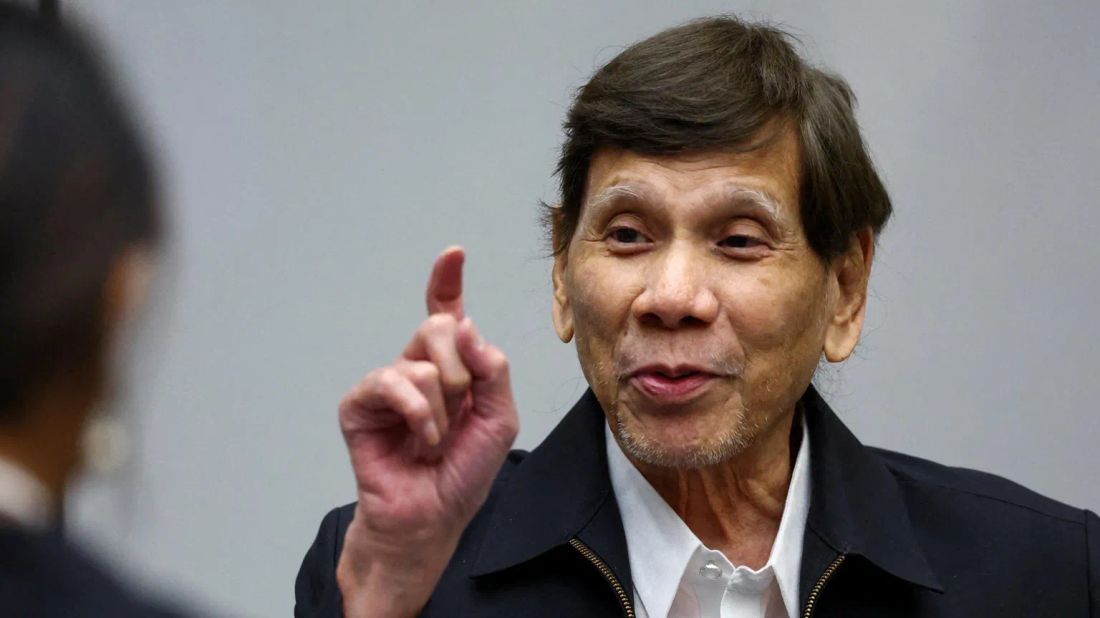
Former Philippine President Rodrigo Duterte's ability to participate in his trial before the International Criminal Court (ICC) is "extremely limited" because of cognitive impairment that prevents him from providing meaningful instructions to his defense team, his lawyer said in a court filing.
In a 77-page submission dated Nov. 25, 2026, Peter Haynes, King's Counsel, who represents Duterte, said the former president's condition has significantly affected his ability to understand the proceedings, recall relevant events and assist in preparing his defense against charges of crimes against humanity.
"The exponential increase in the volume of Prosecution disclosure after the confirmation of charges has undermined Mr. Duterte's ability to prepare his defence," Haynes said.
He noted that the challenge was compounded by Duterte's cognitive impairment, which prevents him from giving his lawyers meaningful instructions or reviewing the more than 62,000 items in the evidentiary record.
"Although Mr. Duterte is physically present, his ability to contribute to his defence is virtually non-existent," the lawyer said.
Haynes said Duterte could no longer reliably remember events that happened more than a decade ago, including those covered by the case, as well as incidents that took place only hours earlier.
His recollection of matters relevant to the charges was described as fragmented, disconnected and incomplete, with some memories entirely absent.
The defense also cited assessments by experts appointed to examine Duterte, which documented significant cognitive difficulties, including attention deficits, word-finding difficulties, short-term memory problems, and visuospatial and executive dysfunction.
According to the filing, Duterte was unable to remember meeting the experts just months earlier, recall the names of certain family members, or consistently identify the counsel representing him despite their regular visits.
Haynes said that despite repeated explanations of the charges over more than 20 months, Duterte's understanding of the allegations remained superficial.
A neurologist who assessed the former president also acknowledged that his memory deficits could affect his ability to answer the court and provide his lawyers with a rational, coherent and sequential account of the alleged criminal events.
Although the ICC Pre-Trial Chamber previously found Duterte fit to stand trial, the defense argued that his cognitive limitations continue to obstruct the effective preparation of his case and could worsen over time.
Haynes stressed that Duterte's participation was essential given the temporal and geographical scope of the allegations, saying his lawyers needed to discuss evidence with him, hear his views and obtain meaningful instructions.
The filing quoted one of the experts who recently examined Duterte as saying that "everything discussed at one meeting is forgotten by the next."
"This is the reality in which Mr Duterte and his Defence team are about to embark on this trial," Haynes said.
The defense also questioned the ICC's handling of the case, arguing that the alleged killings should instead be prosecuted in the Philippines with the cooperation of the ICC Office of the Prosecutor.
Haynes described the proceedings as "obscene and perverse," arguing that the process had removed the killings from a domestic judicial system capable of addressing them and transferred them to an international case that, in the defense's view, could not succeed because of Duterte's condition.
He maintained that the Philippines should try the killings domestically, using an evidentiary record stripped of what the defense characterized as tainted and corrupted evidence linking Duterte to the alleged crimes.
Duterte, 81, is facing ICC proceedings over alleged crimes against humanity linked to killings during his administration's war on drugs and the earlier campaign against illegal drugs in Davao City.