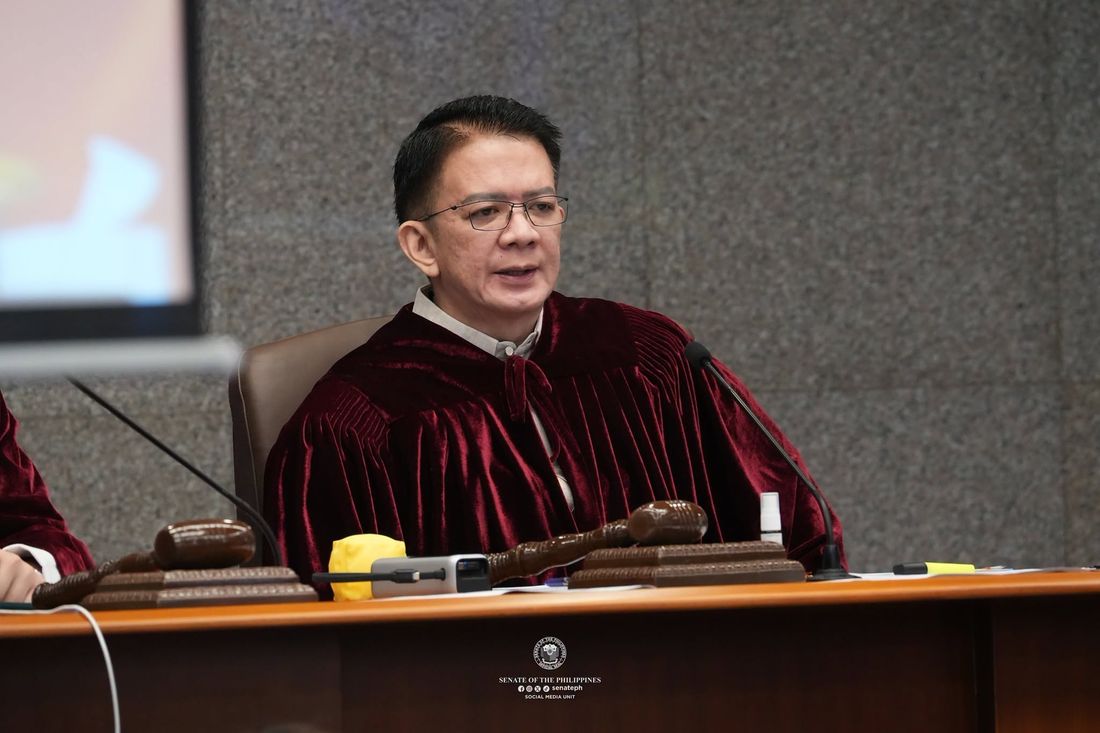
Senate impeachment court Presiding Officer Francis “Chiz” Escudero on Thursday reminded senator-judges and the prosecution and defense teams to respect the rights of witnesses and exercise restraint during the impeachment trial of Vice President Sara Duterte.
This came after exchanges during the previous trial in which some witnesses faced criticism from senator-judges.
Speaking on the 43rd day of the proceedings, Escudero stressed that witnesses must be treated with fairness and dignity, emphasizing that an unsatisfactory answer does not automatically constitute contempt.
“The chair wishes to place on record and remind the council for both parties and our distinguished senator judges, including the presiding officer, that while every witness takes an oath before this court to testify truthfully to answer all questions,” Escudero said.
“The chair wishes to emphasize that an answer which may be unsatisfactory is not inherently contemptible. Supreme Court cases have cautioned courts to use the power of contempt with the highest restraint,” he added.
He also reminded senator-judges, including himself, to exercise patience when examining witnesses, noting that the proceedings must be conducted impartially despite frustrations over their responses.
Escudero said the court’s rules require all parties to receive and evaluate evidence “impartially“ and exercise “utmost patience,” particularly given the lengthy examinations conducted by both sides.
“I wish to also remind the counsel for both parties as well as our fellow senator-judges, including this representation, that while we may rigorously examine witnesses and test the credibility of their testimonies, we must refrain from a manner of questioning and from making declarations that elicit fear rather than candor,” Escudero said.
Further, Escudero cited Section 3, Rule 132 of the Rules on Evidence, which outlines the rights and obligations of witnesses, including the following:
- A witness must answer questions, although his answer may tend to establish a claim against him. However, it is the right of a witness number one to be protected from irrelevant, improper, or insulting questions and from harsh or insulting demeanor.
-
Not to be detained longer than the interests of justice require
-
Advertisement
Not to be examined except only as to matters pertinent to the issue
Not to give an answer which will tend to subject him to a penalty for an offense unless otherwise provided by law
-
Not to give an answer which will tend to degrade his reputation, unless it is the very fact at issue or to a fact from which the fact in issue would be presumed. But a witness must answer to the fact of his previous final conviction for an offense.
He also acknowledged that answers such as “I do not know” and “I do not recall” could be frustrating, but said the parties must remain composed and focus on evaluating the evidence presented before the court.
“What we can control, however, is how we appreciate and weigh the testimonies and statements delivered before this court,” he said.
“We owe it to the parties, to the witnesses, and to the institution we represent to conduct the proceedings still with fairness, dignity, and respect in spite and despite our frustration and/or disappointment with what the witness may or may not be saying,” he added.