
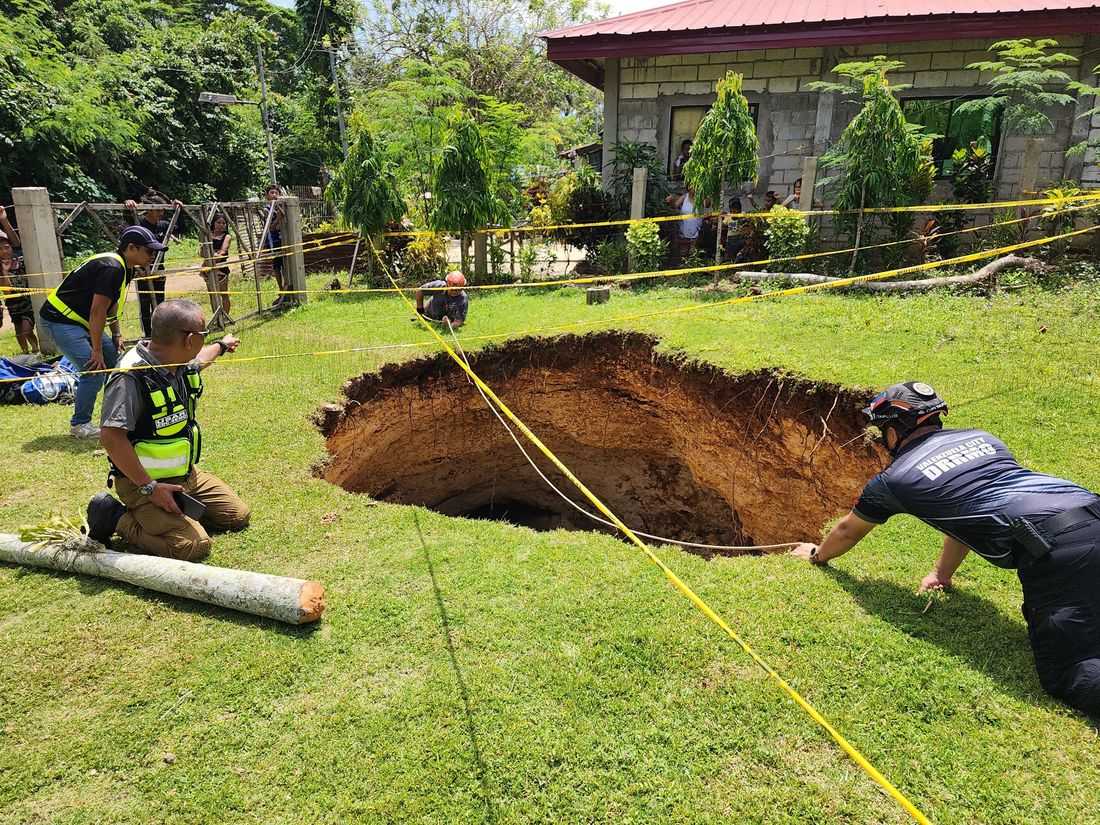
Department of Science and Technology (DOST) Secretary Renato Solidum explained on Saturday that the appearance of sinkholes in Cebu is due to the province’s geological composition, noting that many areas are made up of limestone.
In an exclusive interview on DZRH’s Special on Saturday, Solidum explained that limestone is a type of stone that easily dissolves when water seeps through it, making affected areas more prone to sinkholes.
Following reports of multiple sinkholes after the 6.9-magnitude earthquake in Cebu, the DOST Secretary explained the science behind the phenomenon.
Sinkholes often go undetected because the ground above them remains intact, either because it hasn’t been shaken by a strong earthquake or the underground cavity has yet to collapse, according to Solidum. He added that a sinkhole is likely to form if the surface layer becomes too thin, if a powerful quake causes the ground to give way, or if large volumes of water seep through and weaken the ground, eventually causing it to cave in.
Solidum also added that in some areas, particularly along roads with drainage systems, sinkholes may form when the road is built on loose fill material. If the drainage pipe underneath gets damaged, water can erode the surrounding soil, gradually removing the support beneath the road and causing it to collapse.
“Pero ito sa Cebu, karamihan ng lugar ay made of limestone kaya ine-expect talaga na posibleng magkaroon ng mga sinkhole sa lugar na ‘yan,” he stated.
Solidum referred to one of the videos of a sinkhole, noting that the hole can extend deeper underneath, with the thinnest layer of the surface being the one that collapsed. The underground void may be much larger than what is visible from above.
He suggested that the best course of action in areas with soft ground foundations is to prepare for possible liquefaction and ensure that proper drainage systems are in place along roads.
Moreover, at least 15 sinkholes were reported in various parts of Cebu, particularly in Barangay Bitoon, Barangay Maño, Barangay Paypay, Sitio Maño, San Remigio, following the earthquake that struck the province, which was later followed by strong aftershocks.
The agency has already dispatched a team to the area to conduct an assessment.
