
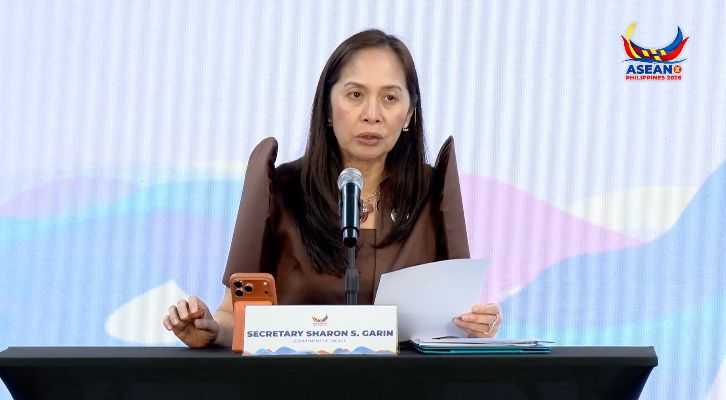
Garin said the initiative is a bilateral undertaking with Japan and is not necessarily an ASEAN-wide stockpiling scheme.
“With Japan, we are currently doing a study on regional stockpiling. It is not necessarily on the ASEAN, it’s with the Japan agreement,” Garin said during a joint press conference on October 8, on the sidelines of the Asia Zero Emission Community (AZEC) Ministerial Meeting.
The Department of Energy (DOE) is working with the Philippine National Oil Company (PNOC), as well as oil-producing countries and companies, to assess the feasibility of the proposed facility, according to Garin.
“We are studying establishing regional stockpiling location in the Philippines, and together with DOE, they’re working with PNOC and some of oil-producing countries or companies,” Energy secretary said.
“It is a convergence of many institutions, but the intent is to study the possibility of the Philippines being a regional stockpiling location,” she added.
Garin noted that Japan is assisting the Philippines through the Japan International Cooperation Agency (JICA) and the Ministry of Economy, Trade and Industry (METI), which will help facilitate the preparatory work before any decision is made on the project.
She added that the two countries are conducting feasibility and other necessary studies to determine whether the facility should be established in the Philippines, including its possible location and logistical requirements.
“Japan is working with us with JICA and METI to facilitate all the preparatory work that's needed before we even construct or decide on the project,” she said.
“We are doing feasibility study and all the other study that is necessary to determine if we establish it in the Philippines and, if we do, where and how logistics will be. Parang sila 'yung partner natin in the study of regional stockpiling,” Garin added.
The Energy chief said the timeline for the proposed facility and the potential investment required have yet to be determined.
The regional stockpiling initiative is separate from the country's planned national strategic petroleum reserve, which targets the completion of its first one-million-barrel storage tank by the end of 2027.
