
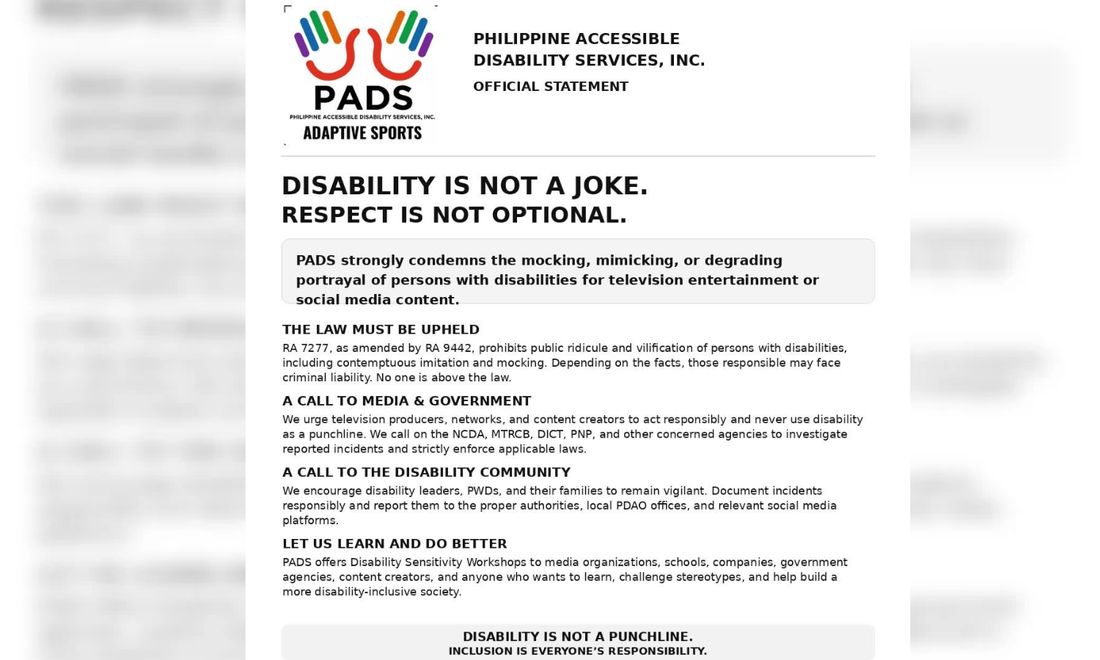
The Philippine Accessible Disability Services Inc. (PADS) has condemned the use of persons with disabilities (PWDs) as subjects of mockery and imitation for entertainment, publicity, or social media engagement
“Disability is not a joke. Human dignity is not entertainment,” PADS said in a statement on Sunday, Nov. 22.
“The everyday struggles, physical limitations, communication barriers, and social challenges experienced by persons with disabilities are real. They are not props for comedy, punchlines for television, or content material to generate views, likes, and online popularity,” it added.
PADS called on television personalities, reality show participants and content creators to use their platforms responsibly and avoid behavior that humiliates, stereotypes or undermines the dignity of persons with disabilities.
“Public figures, producers, and content creators must understand that their actions carry influence and consequences,“ the group noted.
It also reminded the public that Republic Act No. 7277, or the Magna Carta for Persons with Disabilities, as amended by Republic Act No. 9442, prohibits making fun of, contemptuously imitating or mocking PWDs because of their impairments.
The law's implementing rules and regulations specifically identify offensive imitation of persons with disabilities in television shows, broadcast media, stage performances and other forms of entertainment as acts of public ridicule.
Under Section 46 of RA 7277, as amended by RA 9442, violators may face a fine of ₱50,000 to ₱100,000, imprisonment of six months to two years, or both, for a first offense.
For subsequent violations, penalties increase to a fine of ₱100,000 to ₱200,000, imprisonment of two to six years, or both, at the discretion of the court.
PADS added that officials directly involved may also be held liable when the violation is committed by a corporation, organization, or similar entity.
The group urged the appropriate government agencies to investigate reported incidents, determine the circumstances surrounding them and pursue legal action against those found responsible.
“Accountability must not be compromised simply because the individuals involved are celebrities, public personalities, or influential content creators,” PADS said.
It also called on television networks, program producers, directors, creative teams and digital content platforms to “exercise greater sensitivity and accountability in producing and distributing entertainment contents.“
“The entertainment industry has an enormous influence in shaping public attitudes and social behavior. With that influence comes the responsibility to protect the dignity of marginalized sectors,” it said.
“Entertainment should never come at the expense of another person’s dignity,” the organization added.
The group urged the National Council on Disability Affairs (NCDA), Movie and Television Review and Classification Board (MTRCB), Department of Information and Communications Technology (DICT), Philippine National Police (PNP), local Persons with Disability Affairs Offices (PDAOs) and other concerned agencies to strictly enforce existing laws and regulations.
“The full force of the law must be applied where violations are established. These incidents must serve as a reminder that disability rights are human rights, and that no individual or institution is above the law,“ PADS said.
It also encouraged disability rights advocates, PWD organizations, persons with disabilities and their families to remain vigilant, document incidents responsibly, preserve relevant evidence and report violations to the appropriate authorities and social media platforms.
PADS stressed that discriminatory behavior should not be normalized simply because it is presented as humor, entertainment, or online content.
“Speaking up is not being overly sensitive; it is standing up for dignity, equality, and human rights,” the organization said.