
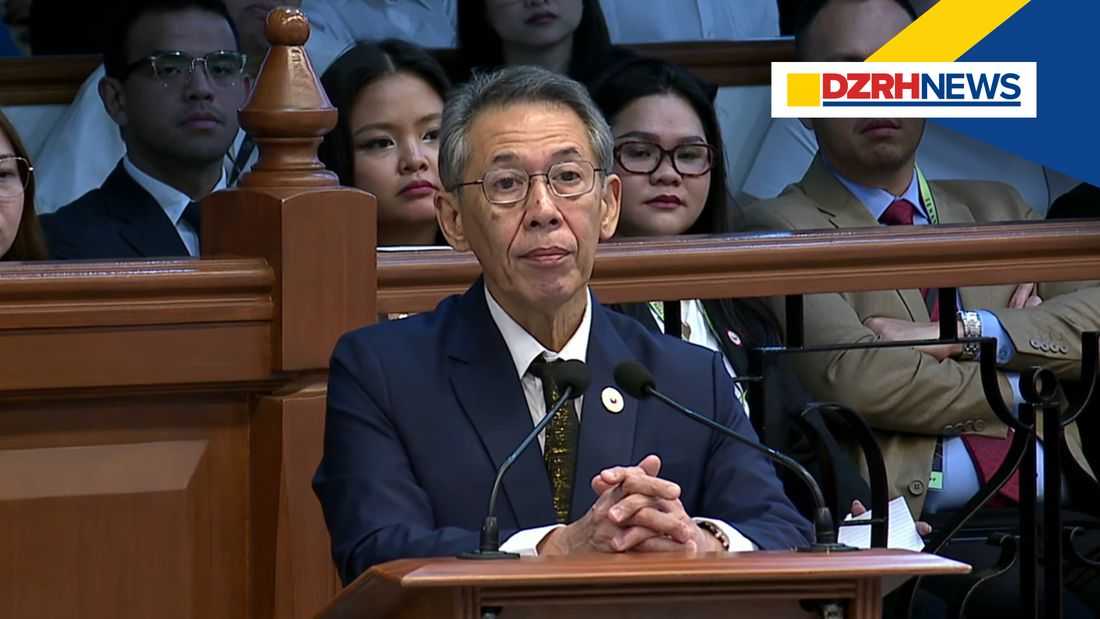
House prosecutor Chel Diokno says the prosecution will continue to fulfill its constitutional duty regardless of the Senate impeachment court’s ruling on the disputed voting threshold in Vice President Sara Duterte’s impeachment trial on Wednesday, September 23.
Diokno says the prosecution remains confident in its case and evidence, regardless of how the Senate impeachment court rules on the required number of votes to convict.
“The prosecution is confident in its case, we believe in our evidence, and we trust the independent judgment of this honorable court. And whatever the threshold is, however this court decides the issue before it today, the prosecution will do its job,” Diokno says.
He says the prosecution’s obligation is to present evidence and prove the allegations, while the impeachment court’s duty is to examine the evidence, weigh the arguments, and decide in accordance with the Constitution and the law.
Diokno also cites the testimonies of four former Supreme Court justices who appeared as amici curiae before the Senate last week. He notes that while the former justices offered different interpretations of the phrase “all members of the Senate,” they all agreed that the required number of votes to convict is not necessarily fixed at 16.
“The Constitution requires two-thirds. The question before this court is two-thirds of how many?,” Diokno says.
He emphasizes that the prosecution is not asking the court to adopt one particular interpretation from the former justices, saying the decision ultimately belongs to the Senate impeachment court.
Instead, Diokno frames the issue around the constitutional principle of accountability, pointing to Article XI, Section 1 of the 1987 Constitution, which states that public office is a public trust and public officers must remain accountable to the people.
“Our 1987 Constitution may properly be understood in its essential respects as an accountability constitution. Isang saligang batas ng pananagutan,” Diokno says.
He adds that accountability has two sides: answerability, or an official’s duty to respond when required by the Constitution, and responsibility, or the duty of constitutional institutions to perform their functions properly.
Diokno says these principles are central to the impeachment process as the Senate considers the disputed threshold before proceeding with the trial.
