
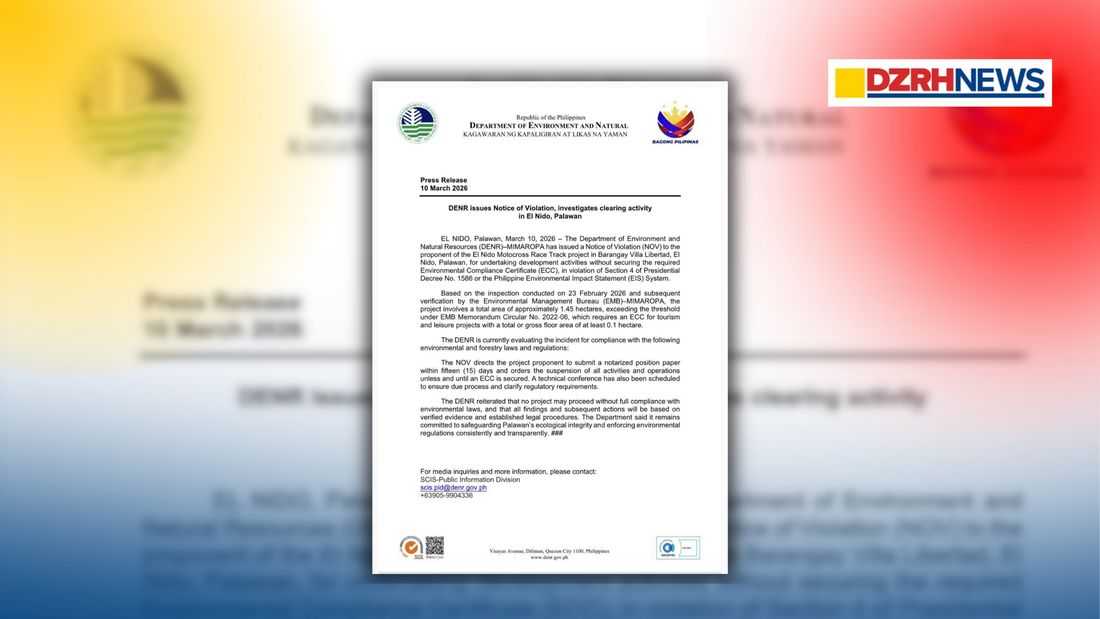
The Department of Environment and Natural Resources (DENR) has issued a Notice of Violation against the developer of a motocross race track project in El Nido, Palawan, for conducting land clearing and development activities without securing the required environmental permit.
According to the DENR–MIMAROPA regional office, the project in Barangay Villa Libertad began development without obtaining an Environmental Compliance Certificate (ECC), which is mandatory under Presidential Decree No. 1586 or the Philippine Environmental Impact Statement (EIS) System. The ECC is required for projects that may have significant environmental impacts and serves as proof that environmental risks have been assessed and mitigation measures are in place before construction begins.
An inspection conducted by the Environmental Management Bureau (EMB) on February 23, 2026, found that the planned motocross race track covers around 1.45 hectares, exceeding the 0.1-hectare threshold set under EMB Memorandum Circular No. 2022-06 that requires tourism and leisure projects to first secure an ECC.
Because of the violation, the DENR ordered the immediate suspension of all project activities and operations unless the developer obtains the required environmental clearance. The project proponent was also directed to submit a notarized position paper within 15 days explaining the development and its compliance with environmental regulations. A technical conference with DENR officials has also been scheduled as part of the investigation.
The agency said it is currently evaluating the project for possible violations of environmental and forestry laws. DENR stressed that no development project may proceed without full compliance with environmental regulations, emphasizing the government’s commitment to protecting Palawan’s ecological integrity while ensuring proper regulatory enforcement.
Palawan, particularly El Nido, is known for its protected marine and forest ecosystems and is considered one of the Philippines’ most important ecotourism destinations, making strict environmental compliance crucial for new tourism-related developments.
