
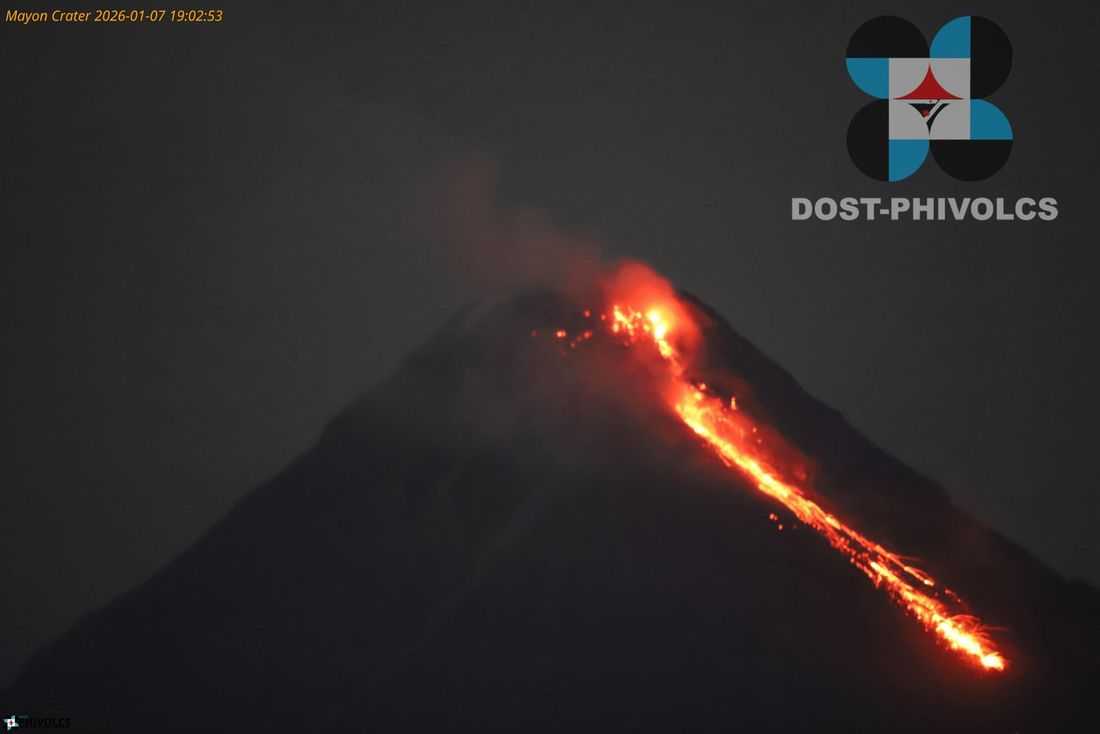
A crater glow, locally known as "banaag", was observed at the summit of Mayon Volcano on Wednesday evening, as state volcanologists continued to monitor the volcano’s high activity.
According to the Philippine Institute of Volcanology and Seismology (PHIVOLCS), the glow was visible between 6:36 p.m. and 7:00 p.m., caused by superheated volcanic gas from newly extruded magma lighting up the atmosphere above the crater. An incandescent lava dome was also seen at the summit, shedding new material from rockfalls and pyroclastic density currents (PDCs) into the Bonga Gully.
Alert Level 3 remains in effect over Mayon, which was raised on Tuesday, January 6. PHIVOLCS continues to advise the public to avoid the volcano’s six-kilometer Permanent Danger Zone (PDZ), citing the extreme hazard of PDCs—fast-moving mixtures of hot gases, ash, and volcanic rock capable of reaching temperatures of up to 1,000°C.
From Tuesday to Wednesday, PHIVOLCS recorded one volcanic earthquake, 162 rockfall events, and 50 PDCs. A 200-meter-tall plume of moderate emissions rose above the volcano, drifting northeast, while sulfur dioxide emissions reached 702 tons per day. Ground deformation continues to be observed, indicating magma movement beneath the volcano.
In the past 24 hours, pyroclastic density currents surged further, though PHIVOLCS clarified that this does not signal a stronger eruptive phase. Between midnight of January 7 to January 8, 50 PDCs were logged, including a lava dome collapse at 6:51 a.m. that sent gray ash clouds rising up to 1,000 meters, drifting west-northwest. Thin ashfall was reported in Legazpi City, Ligao City, and the towns of Bacacay, Camalig, and Daraga.
At 11:40 a.m., PHIVOLCS observed a newly formed dark lava dome at the summit, shedding PDCs along the Miisi Gully. By midday, 49 PDCs were recorded along the Basud, Bonga, and Miisi gullies.
PHIVOLCS warned that Mayon could be placed under Alert Level 4 if there is a sudden increase in volcanic earthquakes, rapid lava extrusion, lava fountaining, or significant changes in sulfur dioxide emissions.
Meanwhile, Bicol's tourism department said they are anticipating a possible increase in tourist arrivals in Albay following the event due to its scenery.
Mayon, the Philippines’ most active volcano, has erupted more than 50 times over the past four centuries. Its most destructive eruption occurred in February 1814, killing an estimated 1,200 people.
The country sits within the Pacific Ring of Fire, a region prone to frequent volcanic and seismic activity.
