


Several Filipino beauty queens have spoken out in support of inclusive Filipino identity and national pride following a viral “halfies” remark by two male pageant titleholders.
The discussion stemmed from an exchange involving Filipino-American pageant titleholders Brandon Espiritu and Jether Palomo, where comments referring to “halfies” and language use in a pageant-related gathering drew criticism from netizens.
In response, prominent figures in Philippine pageantry emphasized that Filipino identity goes beyond lineage or “blood quantum,” highlighting values such as service, pride, and lived cultural connection.
Miss Universe 2018 winner Catriona Gray stressed that many Filipinos with mixed heritage continue to make meaningful contributions to the country. She said platforms in pageantry and beyond should be given to individuals who consistently demonstrate commitment to Filipino values.
“Let’s give a platform (pageantry or otherwise) to people who truly deserve it; those whose love for country extends beyond a momentary spotlight,” Gray said. “Those whose pagmamahal sa bayan is more than just lip service, but is reflected in their consistent actions, character, and values.”
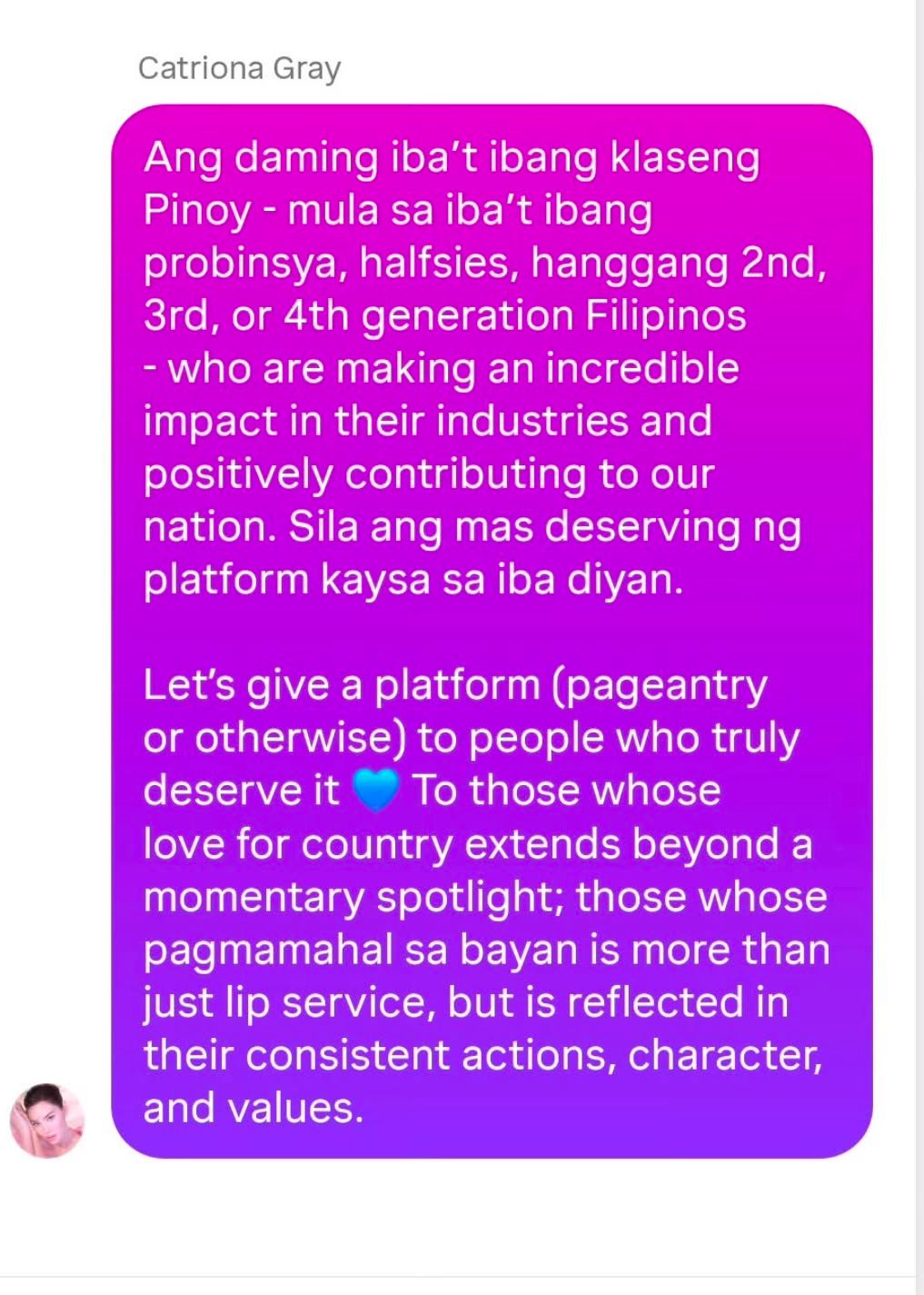
(Photo courtesy: Screengrab from Gray's Instagram channel)
Miss Grand International 2025 representative Emma Tiglao echoed a similar view, saying that being Filipino is defined by pride and love for the country rather than ancestry.
“For me, being Filipino is not about being half or pure. It’s about the love you have for your country, the pride you carry, and the heart you put into representing it,” Tiglao said in a Facebook post.
“At the end of the day, what matters most is not what’s in your blood, but what’s in your heart.”
Cebuana beauty queens also joined the conversation, reinforcing similar sentiments. Miss Grand International (MGI) All-Stars Top 5 finalist Gazini Ganados said she is proud to be a Filipina and emphasized that being Filipino is not measured by blood.
“Halfies or not, no one can dictate what it means to be Filipino,” Ganados said in a Facebook post. “My love for the Philippines is not measured by blood quantum, but by the pride, respect, and service I give to my country.”
Meanwhile, Top 5 in the Miss Universe 2025 Beatrice Luigi Gomez described her Filipino identity as both personal and deeply rooted in her heritage.
“I am a proud Bisaya, with roots from Tuburan, Cebu and Iligan City. I was never considered a frontrunner and carried the banner of my hometown, Cebu, as a dark horse,” Gomez said in a Facebook post.
“To call myself Filipino is more than an identity, it is my pride, honor, and purpose,” she added.
Miss Philippines Charm 2027, Filipina-Black American Apriel Smith also shared her experience growing up mixed-race, noting that identity struggles did not weaken her commitment to representing the Philippines.
“As someone who grew up being bullied for being mixed-race, those experiences were not always easy,” Smith said. “Yet despite it all, I chose to keep fighting for the Philippines.”
The beauty queen then cited her answer during her MUPH 2026 stint, “But as long as we know that we show up and we don’t just share struggles, but we share the stories of hope, culture, and heritage for us being Filipino. I am incredibly excited and honored to represent our country. Mabuhay tayong mga Pilipino.”
Miss Grand International 2024 winner CJ Opiaza likewise said Filipino identity cannot be reduced to purity of lineage.
“May halo mang banyaga ang aking dugo, sa bawat pagkakataong ipinagkakaloob sa akin ay buong puso kong ipagsisigawan sa mundo na ako ay Pilipino. Sapagkat ang aking nasyonalidad ay hindi lamang dumadaloy sa aking dugo, kundi namumuhay sa aking puso, at patuloy kong ipapamayagpag sa bawat pagkakataong maitaas ko ang bandila ng Pilipinas,” she said.
Former Miss World Asia Krishna Gravidez underscored pride in both regional roots and national identity, emphasizing unity among Filipinos.
“A proud, Ilokano-Bisaya—pure-blooded Filipina who made it because of her roots, her heritage, and most importantly, the united patriotic strength of the Filipino people,” Gravidez said.
The viral debate continues to circulate online, with many netizens and pageant fans weighing in on what defines Filipino identity in modern society.
Espiritu and Palomo have issued apologies after backlash grew online.
