

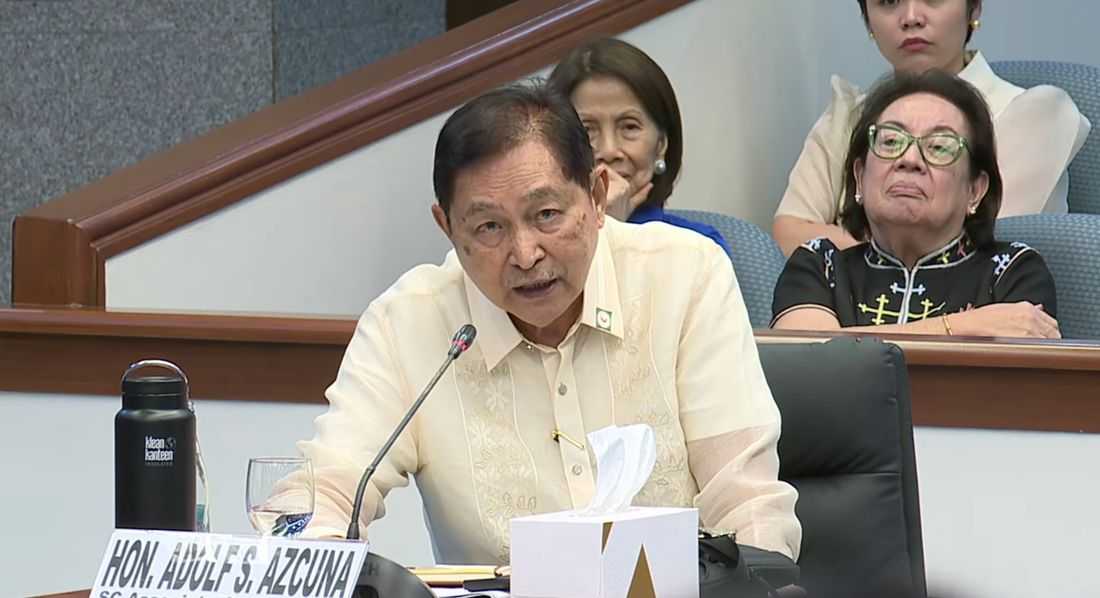
Retired Supreme Court Associate Justice Adolfo Azcuna said Wednesday that the two-thirds vote required to convict in an impeachment trial must be based on all members of the Senate, not only those present or participating in the proceedings.
Appearing as amicus curiae before the Senate Impeachment Court on the 26th day of the impeachment trial of Vice President Sara Duterte, Azcuna said the phrase “all the members of the Senate” under Article 11, Section 3(6) of the 1987 Constitution should refer to the Senate’s full membership.
“I respectfully submit, Your Honors, that the reference in this provision is to all members of the Senate, as long as they are members of the Senate. They constitute the denominator in computing the threshold of two-thirds because all means all,” Azcuna said.
Azcuna argued that the threshold must remain fixed and should not change depending on the number of senators attending or participating in the trial.
He said using only the number of participating senators could effectively lower the constitutional requirement. For example, if only 20 senators participate, two-thirds would amount to 13 or 14 votes, which he said would effectively make conviction possible through a simple majority.
“That is not the purpose of the internal check of a threshold. A threshold must be fixed, not variable. It must be determinable from the start,” Azcuna said.
Azcuna described impeachment as a “political judicial hybrid exercise” involving the removal of a sitting elected official and said its consequences justify a higher voting threshold.
He said the two-thirds requirement serves as a safeguard against partisan or factional use of impeachment and helps ensure that a conviction is supported by broad consensus.
Azcuna also said the 1935 Constitution and the Supreme Court’s ruling in Avelino v. Cuenco do not control the issue because the constitutional wording involved in that case differed from the present provision.
On whether senators who were absent from some impeachment proceedings may still vote on the final verdict, Azcuna said the matter should be left to the Senate’s own rules.
He said that, in his personal view, such a senator-judge should be allowed to vote if the senator believes they can render an impartial judgment based on the official record, transcripts, and documentary evidence.
“If there is no rule in the Senate as to that, what is my opinion? I think, Your Honor, in case of doubt, I would allow such a person to vote because this tribunal is a tribunal of record,” Azcuna said.
He stressed, however, that this was his personal view and that the issue remained an internal matter for the Senate to decide.
Watch the full video statement below:
