
MANILA, Philippines – Member states of the Association of Southeast Asian Nations (ASEAN) expressed serious concern over the escalation of conflict in the Middle East following the attacks initiated by Israel and the United States against Iran on 28 February 2026, with its impact now being felt in the region and around the world.
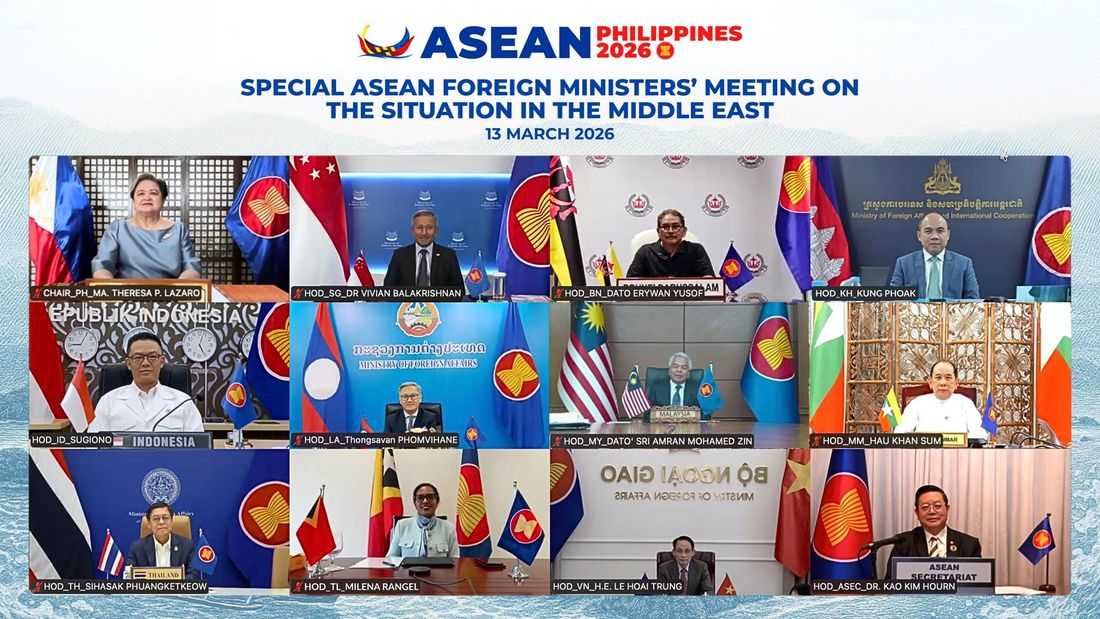
In a virtual press briefing, Department of Foreign Affairs (DFA) Secretary Ma. Theresa Lazaro shared the ASEAN Foreign Minister’s statement on the situation in the Middle East in their recent virtual meeting, chaired by the Philippines, to “exchange views on the evolving situation in the region and its implications for ASEAN.”
“The Meeting discussed the impacts of the conflict in the Middle East on global economic activity, particularly energy markets and maritime and air transport routes, and underscored the importance of maintaining stable, open, and reliable global energy supply chains and maritime trade routes, and minimising disruption to the flow of energy and essential goods, including food, to safeguard economic stability in ASEAN,” the statement read.
The ASEAN Foreign Ministers also underscored the importance of strengthening regional energy security and economic resilience and emphasised the value of ASEAN solidarity, economic integration, and coordination in policy and joint effort to navigate external economic shocks and mitigate their potential impact and spillover effects on regional macroeconomic and financial stability, including finance sectors, supply chains, the cost of living as well as the lives of people across ASEAN.
The meeting highlighted the importance of strengthening regional connectivity, enhancing cooperation on energy preparedness, and advancing efforts to diversify energy sources, including renewable and alternative energy, and further emphasised the importance of facilitating trade, strengthening logistics connectivity, and reinforcing supply chain resilience to help ensure stable access to affordable essential goods, especially food and food products, across ASEAN, the statement added.
Due to the expanding effects of the crisis in the Middle East, the ASEAN Ministers called for making full use of existing ASEAN mechanisms and frameworks to enhance consultation, information sharing, and cooperation among ASEAN Member States and emphasised that ASEAN already possesses practical mechanisms and initiatives that can be further mobilised and strengthened to enhance regional resilience, including the ASEAN Framework Agreement on Petroleum Security (APSA), the ASEAN Power Grid (APG) Enhanced Memorandum of Understanding, and the Trans-ASEAN Gas Pipeline (TAGP), as well as cooperation with relevant sectoral bodies and industry stakeholders.
The ASEAN Foreign Ministers also committed to intensify synergy among relevant ASEAN sectoral bodies, including those responsible for economic, finance, transport, food and agriculture and energy cooperation, in order to strengthen regional preparedness and resilience.
“The Meeting stressed the importance of deeper cooperation under the ASEAN Economic Community in sustaining ASEAN’s role as a reliable hub for trade, investment, and production networks amid evolving global challenges, as well as closer coordination between ASEAN Foreign and Economic Ministers to promote a more synergised and timely response to crises, and in this regard, welcomed the issuance of the Joint Statement of the ASEAN Economic Ministers on Strengthening ASEAN’s Economic Resilience in Response to Recent Global Economic and Geopolitical Developments,” the statement said.
The ASEAN Foreign Ministers is pushing for the immediate cessation of hostilities and called on all parties concerned to exercise utmost self-restraint, avoid any acts that may further aggravate the situation, and resolve differences through diplomacy and dialogue in the interest of maintaining peace and stability in the region.
“The Meeting underscored the importance of maintaining regional peace, stability and prosperity, upholding international law, and promoting dialogue and diplomacy as the primary means of addressing conflicts and tensions. The ASEAN Foreign Ministers agreed to continue to monitor the situation in the Middle East and to coordinate to address its implications for ASEAN,” the statement mentioned.
