
MANILA, Philippines – The foreign ministers of the Association of Southeast Asian Nations (ASEAN) expressed “serious concern” over the rapidly evolving situation in the Middle East, particularly the renewed hostilities involving the United States of America and the Islamic Republic of Iran, according to a statement released on Tuesday.
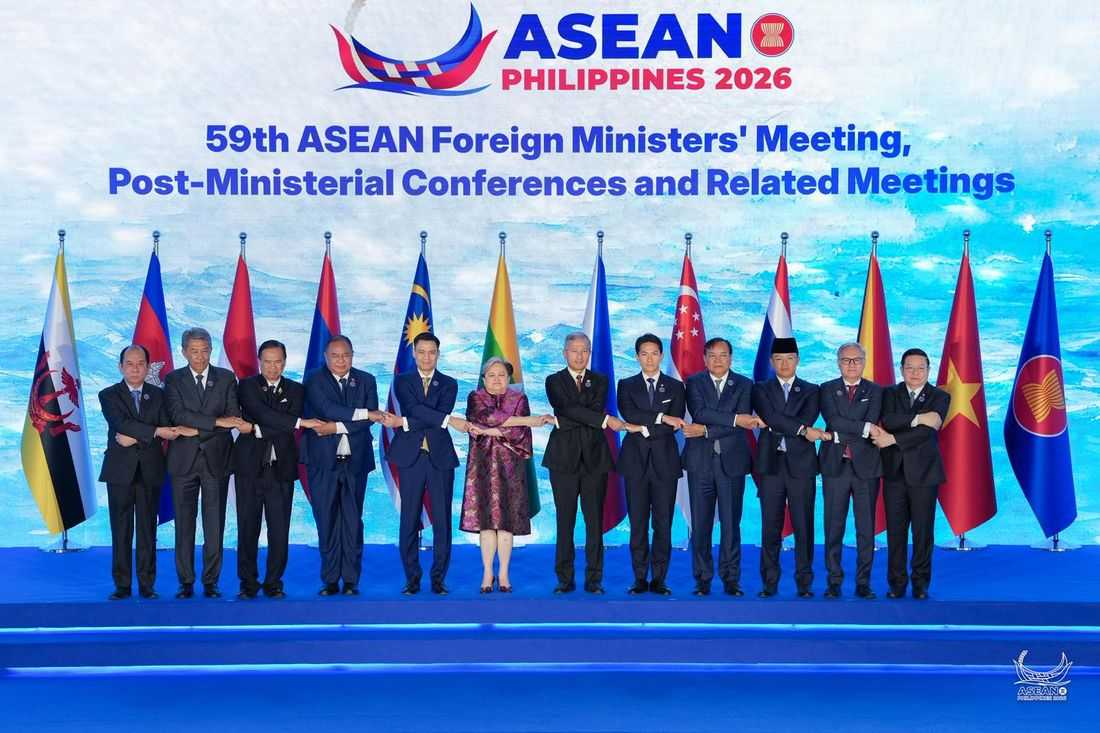
Foreign Ministers converge this week in Manila for the 59th ASEAN Foreign Ministers’ Meeting (AMM), Post-Ministerial Conferences (PMC) and Related Meetings, and the Commemorative Activity of the 50th Anniversary of the Treaty of Amity and Cooperation in Southeast Asia (TAC).
Top diplomats from the region are expected to discuss pressing regional and global issues, including the situation in the Middle East and the issue of territorial disputes in the South China Sea.
In the statement, the foreign ministers called for all parties concerned to “exercise utmost self-restraint” and avoid any acts that may further aggravate the situation.
“We are deeply concerned that these developments severely undermine the ongoing efforts of key mediators and diminish the prospects for a peaceful resolution through dialogue and diplomacy,” the statement read.
The foreign ministers also underscored the importance of maintaining regional peace, stability and prosperity, upholding international law, and promoting genuine dialogue and diplomacy in addressing conflicts and tensions, including the need for a complete and immediate cessation of hostilities across all fronts in the Middle East.
Last April, the Member States of the ASEAN welcomed the two-week ceasefire between the U.S. and Iran, announced on 8 April 2026.
In a statement, the ASEAN Foreign Ministers reaffirmed the importance of maintaining maritime safety and security, and uphold freedom of navigation in and overflight above the straits used for international navigation, in accordance with international law.
Tensions flared once again as U.S. military said on Monday that it finished its latest round of strikes on Iran, hitting Iranian military command centers, missile and drone launch sites, maritime capabilities and air defense systems, according to a report from Reuters.
This is after a ceasefire was pushed by mediators to revive a collapsed interim deal. The temporary peace broke down in July 2026 after a series of deadly attacks, prompting the U.S. to resume airstrikes on military targets and enforce a naval blockade, the report mentioned.
The ASEAN foreign ministers also called out the “discriminatory or unilateral measures, that may impede or obstruct vessels passing through the Strait of Hormuz” which is inconsistent with international law, as reflected in the 1982 UNCLOS, and called for the restoration of the safe, unimpeded, and continuous transit of passage vessels and aircraft in the Strait of Hormuz.
The continued tensions in the Middle East also has grave implications on regional trade, energy and food security, including energy markets and supply chains, agricultural production, and the stability of agricultural input supply chains, particularly fertilizers.
“We underscored the importance of strengthening cross-pillars and cross-sectoral coordination within ASEAN to address the broader implications of evolving global developments which will help sustain ASEAN’s stability, sustainability, resilience, and inclusive growth in an increasingly uncertain and unpredictable global environment,” the statement mentioned.
The statement also re-emphasized the shared commitment to provide emergency assistance to ASEAN nationals in times of crisis, in accordance with the ASEAN Declaration on the Guidelines on Consular Assistance by ASEAN Member States’ Missions in Third Countries to Nationals of Other ASEAN Member States and the Guidelines for the Provision of Emergency Assistance by ASEAN Missions in Third Countries to Nationals of ASEAN Member Countries in Crisis Situations.
The ASEAN Foreign Ministers also reaffirmed the obligations of all States to resolve their differences through peaceful means, and to respect the sovereignty and territorial integrity of all nations, to protect civilians and civilian infrastructure in armed conflicts, and to ensure the safety and security of United Nations peacekeepers and humanitarian personnel, in accordance with international law, including international humanitarian law, the UN Charter, and relevant UNSC resolutions.
