
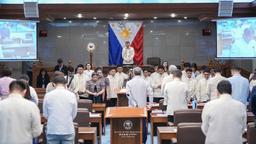

An “active baseline,” consisting of present individuals rather than the Senate’s full 24-member composition, may be considered in determining quorum in cases where intervening events prevent the chamber from assembling its complete membership, according to a political analyst.
Speaking on DZRH’s Magandang Umaga Pilipinas, political analyst Amado Valdez argued that while the Constitution sets the Senate’s total membership at 24, extraordinary circumstances may justify adjusting the basis for quorum computation to avoid institutional paralysis.
Under the Constitution, a majority of 24 senators—13 members—is required to constitute a quorum. However, Valdez said this standard may not be practical in situations where it is “impossible” to gather the full membership due to detention or absence.
“Dapat 13. Ayan ang nakatakda sa ating Constitution,” Valdez said. “Pero may mga tinatawag na intervening events… mga hindi inasahang pangyayari na nababago ang sitwasyon.”
He cited scenarios where some members may be unable to attend proceedings, including cases involving detained or absent lawmakers, referring to senators Sen. Jinggoy Estrada and Sen. Ronald “Bato” Dela Rosa in his discussion of hypotheticals affecting Senate attendance.
Valdez said such circumstances could reduce the practical “baseline” used to determine quorum, shifting from the full 24-member composition to a lower count reflecting available members.
“So kung imposibleng magkaroon ka ng 24 dahil sa nakakulong nga at nagtatago naman yung isa, ang magiging basis mo ay hindi na yung 24 kundi 21 na o 22,” he said, adding that the quorum requirement should not render the institution incapable of functioning.
He described this approach as an “active baseline,” where the number of senators physically or functionally able to attend becomes the reference point for determining whether a quorum exists.
“Active baseline yung 22, magiging 21 na lang ang magiging basis ng quorum,” Valdez said, stressing that the adjustment is meant to preserve legislative operations.
Valdez also pointed to jurisprudence, referencing the Supreme Court’s ruling in Avelino v. Cuenco, which has long been cited in discussions on legislative quorum disputes. In that case, the Court declined to intervene, classifying the issue as a political question best left to the Senate as a co-equal branch of government.
He said the ruling underscores the principle that the Senate itself has discretion in determining its internal rules, including quorum computation, as part of its constitutional independence.
“Ang magde-determine kung ano ang quorum nila ay yung mismong Senado being a co-equal, independent body na nasa Constitution,” Valdez said.
The analyst acknowledged that critics may question the legality of adjusting the quorum baseline, particularly if it deviates from the constitutional figure of 24. However, he maintained that rigid adherence to the full membership could risk disabling the chamber in exceptional situations.
The issue comes amid renewed debate over Senate proceedings on June 3, when questions were raised about whether the chamber had a valid quorum under contested attendance conditions. Some political groups, including PDP-Laban, have signaled plans to challenge the validity of the session before the Supreme Court.
Valdez said such a legal move may again raise the question of jurisdiction, noting that the Court could treat the matter as a political question outside its review.
At the same time, he said the Senate may still assert its authority to interpret its own rules in determining whether quorum was properly met under prevailing circumstances.
“Ang mag-dedetermine kung ano ang quorum nila ay yung mismong Senado being co-equal, independent body na nasa Constitution,” he said, adding that the core issue remains whether the institution can continue functioning despite members being unable to attend.
