
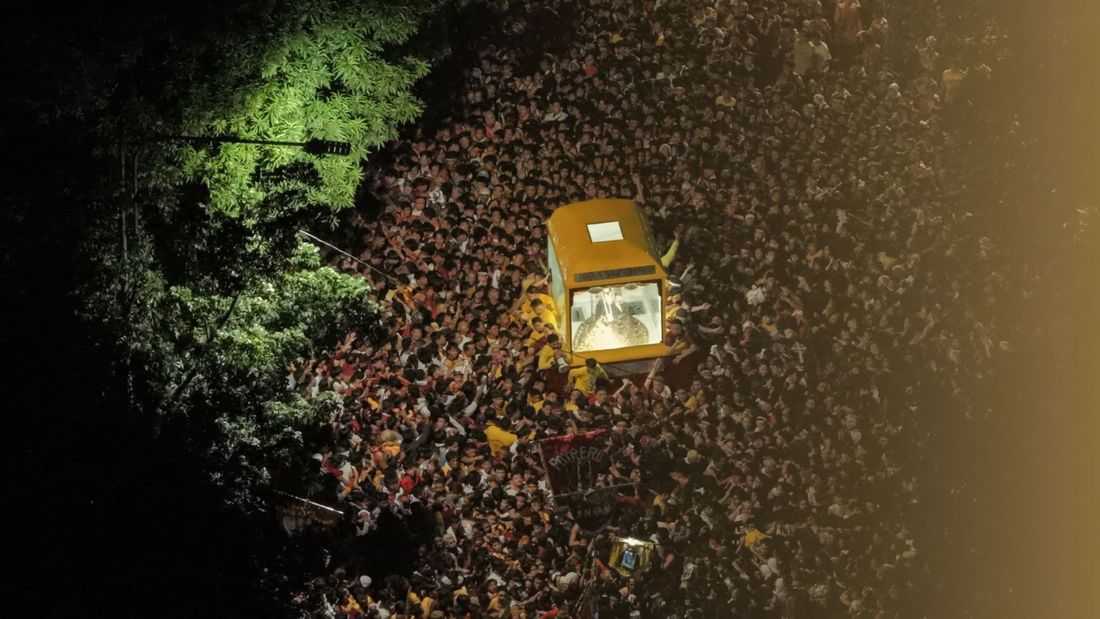
In the still-dark hours of January 9, the annual journey of faith began anew as the Traslacion 2026 officially got underway, drawing tens of thousands of barefoot devotees to the streets even before sunrise.
At around 4 a.m., the revered image of the Hesus Nazareno departed the Quirino Grandstand, marking the start of the traditional procession toward the Minor Basilica of the Jesus Nazarene, more commonly known as Quiapo Church.
The solemn movement followed the midnight Misa Mayor, led by Balanga Bishop Rufino “Jun” Sescon Jr., setting a prayerful tone for what is expected to be another long and grueling day of devotion.
By 5:46 a.m., authorities said the image had already reached Padre Burgos Street, where 95,000 devotees had gathered, many hoping for a glimpse or a chance to touch the andas.
The Traslacion will traverse the following roads, according to the Quiapo Church:
- From Quirino Grandstand
- Left to Katigbak Drive
- Right to Padre Burgos Street through Finance Road
- Straight to Ayala Boulevard
- L Palanca
- R Quezon Boulevard
- R Arlegui Street
- R Fraternal Street
- R Vergara Street
- L Duque de Alba Street
- L Castillejos Street
- L Farnecio Street
- R Arlegui Street
- L Nepomuceno Street
- L Concepcion Aguila Street
- R Carcer Street
- R Hidalgo Street through Plaza del Carmen
- L Bilibid Viejo through Gil Puyat
- R J.P. de Guzman Street
- R Hidalgo Street
- L Quezon Boulevard
- R Palanca Street through under Quezon Bridge
- R Villalobos Street through Plaza Miranda going to Quiapo Church
The Traslacion, widely regarded as one of the largest religious processions in the world, draws millions of Filipino Catholics each year who fulfill personal vows or Panata through physical sacrifice and prayer.
In 2025, the procession stretched to around 20 hours, underscoring both the scale of the event and the intensity of devotion surrounding the Jesus Nazarene.
This year, organizers introduced notable changes aimed at improving safety. The Andas carrying the image now has four wheels instead of three and features a steering mechanism to enhance control amid dense crowds.
The cross borne by the Nazareno was also shortened to discourage devotees from climbing the carriage and risking injury—an issue that has long challenged procession marshals.
Security and medical preparations are again extensive. More than 18,000 personnel from the Philippine National Police have been deployed to manage crowd flow and maintain order, while the Department of Health set up 20 emergency response stations along the route to attend to cases of fatigue, dehydration, and injuries.
As dawn breaks over Manila, the streets remain packed with devotees united by faith, sacrifice, and hope. For many, the long hours ahead are not a burden but a blessing—each step a prayer, each struggle an offering—as Traslacion 2026 unfolds once more as a powerful expression of Filipino Catholic devotion.
